Cardano Meets Solana: Hoskinson & Yakovenko Forge Unprecedented Blockchain Bridge

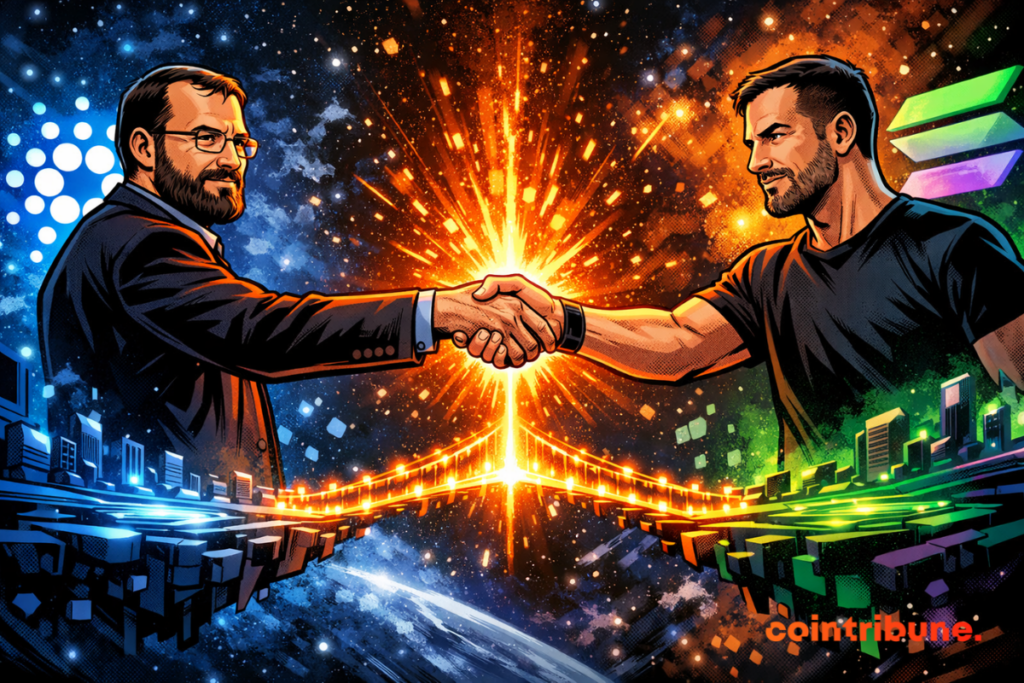
The crypto world's most unlikely alliance just went live. Charles Hoskinson and Anatoly Yakovenko—the founding minds behind Cardano and Solana—have officially launched a direct bridge between their ecosystems. This isn't just another interoperability protocol; it's a handshake between two fundamentally different visions for blockchain's future.
From Rivalry to Relay
For years, the communities debated proof-of-stake elegance versus raw throughput. Now, value and data flow freely between them. The bridge cuts out middle-chain complexity, letting users bypass the usual multi-hop routes. Developers get instant access to two massive, distinct user bases without rebuilding their dApps from scratch.
What Actually Moves?
The technical whitepaper promises near-instant finality for cross-chain transfers. It supports native assets, not just wrapped tokens—a detail that purists will celebrate. The security model leans on a novel cryptographic primitive both teams co-developed, avoiding the single-point-of-failure risks that have plagued other bridges.
The timing is, of course, impeccable—just as institutional money starts asking about 'multi-chain strategies' and 'portfolio diversification.' Nothing boosts a narrative like two top-ten chains deciding cooperation is more profitable than competition. The bridge effectively creates a new, combined liquidity pool that could rival some smaller Layer 1s in total value locked.
One cynical finance jab? Watch the trading volume spike not from actual utility, but from arbitrage bots exploiting the brief latency between the two chains' price feeds—a classic case of infrastructure built for innovation being immediately monetized by the least innovative actors.
This move reshapes the landscape. It's no longer about which chain will 'win.' It's about which networks can integrate without collapsing under their own ideological weight. If Cardano's rigor and Solana's speed can coexist, what other walls might fall next?
 Read us on Google News
In brief
- Cardano and Solana announce an inter-chain bridge to improve liquidity and interoperability.
- Charles Hoskinson and Anatoly Yakovenko put aside their differences to collaborate publicly via X.
- NIGHT, Cardano’s token, surpasses Solana and XRP volumes upon launch.
- Leios, Hydra, and Firedancer aim to solve speed issues without sacrificing decentralization.
Solana and Cardano: clash, ego and desire to come together
The announcement of an inter-chain bridge between Solana and Cardano was not out of the blue. It all started with an altercation on X between Charles Hoskinson and Mert Mumtaz (Helius Labs). The subject? Cardano’s slowness. Hoskinson answered harshly that speed has a price:
It is difficult to be that decentralized while ensuring the security we have. It is easy to be fast—but difficult to be so while maintaining Byzantine fault tolerance of 50%, Nakamoto recovery, and full decentralization.
Against all odds, Yakovenko defends his rival: “Fighting against cardano or XRP is incredibly bearish.” Two yesterday’s enemies agree: create a bridge. A technical gateway to allow ADA tokens to flow on Solana. A Solana developer was invited to start on it immediately.
The clash becomes a catalyst. One tweet, one call, and the entire crypto community wonders: solana and Cardano, complementary? A start of peace in a crypto industry too often plagued by sectarian wars.
Leios, Hydra, Firedancer: the titans gear up for fusion
The two chains long opted for antagonistic visions. Cardano was built on academic rigor, with development in five phases, each adding a brick (governance, scalability, etc.). Solana rushed, broke, fixed. In 2025, things change. The two giants bring out the heavy artillery.
On Cardano’s side, Hydra (layer 2) and Leios aim to multiply transaction throughput by 50 or 60 times. The answer to those who call it a “slow chain.” Solana, for its part, is refining Firedancer, an independent validator client developed with Jump Crypto. Lab tests show 1 million TPS, even if real-world adoption is gradual.
Charles Hoskinson’s chain also appears more inclusive. The NIGHT token, native to the confidential Midnight network, was distributed on eight blockchains, including Solana and XRP. A declaration of war? No. Proof of openness. NIGHT even surpassed combined SOL and XRP volumes in December, reaching 4 billion dollars in 24 hours.
The logic is no longer hostility. Each moves its pieces, but now keeping an eye on the other.
Interoperability, the new eldorado of the crypto industry?
What if the real crypto disruption was not in speed, scalability, or tokenomics… but in interoperability? Hoskinson seems to believe so. For several months, Cardano has multiplied cross-chain initiatives. Midnight is one example, as well as bridges with Bitcoin. Solana, on its side, has already integrated ETH, USDC, DAI via Wormhole.
But a direct ADA and SOL bridge? It’s a first. The MOVE is both technical and symbolic. It initiates a new era where exchange takes precedence over ego. Even the most ardent maximalists call to see Cardano arrive on Solana, just to place their ADA liquidity on Meteora. Others denounce a marketing maneuver. Some, on the contrary, see a stroke of genius.
Other blockchains are closely watching. Avalanche has already ventured into interoperability with Avalanche Warp Messaging. Cosmos has never hidden its ambition to be “the internet of blockchains.” The market loves it. Every interoperable advance attracts users and developers alike.
Figures, volumes and key facts to remember
- The price of SOL at the time of writing is 121.61 dollars;
- The NIGHT token surpassed 4 billion in volume in 24h, ahead of combined SOL and XRP;
- Solana aims for 1 million TPS with Firedancer;
- Cardano promises 50 to 60x more throughput with Leios;
- The ADA–SOL bridge is an unprecedented initiative between two historic rivals.
The bridge between Cardano and Solana is a quiet revolution. Two planets that have continuously rivaled in innovations, each their way. In 2025, Solana even unveils SollPay, a new generation wallet. But today, the trend reverses. Unity, long unlikely, becomes the engine of the future. And this bridge, very real, could well redefine the crypto industry’s map.
Maximize your Cointribune experience with our "Read to Earn" program! For every article you read, earn points and access exclusive rewards. Sign up now and start earning benefits.
