Trump-Backed Stablecoin USD1 Skyrockets Past $3B Market Cap
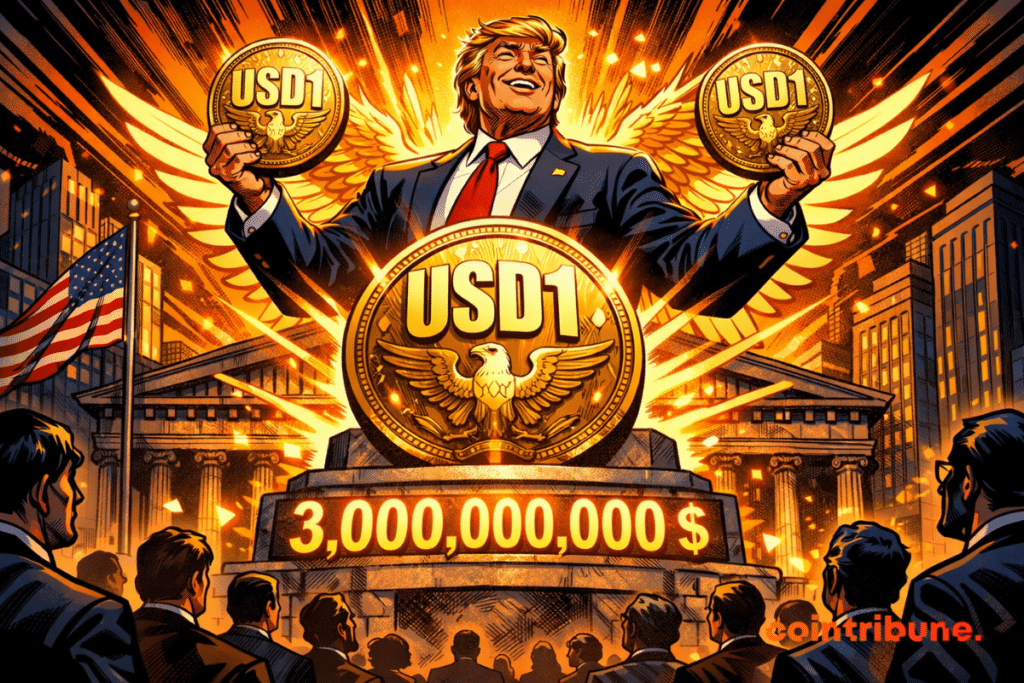
Forget the boring old money—the new political-financial machine just hit a major milestone.
The Numbers Don't Lie
A $3 billion market cap isn't just a number; it's a statement. It means real capital—billions of dollars worth of trust—has migrated onto a blockchain, tethered to a digital asset with a former president's brand stamped on it. That's a level of mainstream adoption that makes traditional finance's cautious crypto 'pilots' look like child's play.
Politics Meets Protocol
This isn't just another stablecoin launch. The 'backed' part is doing heavy lifting, merging political capital with cryptographic assurance. It creates a fascinating, if not unsettling, test case: what happens when a massively polarizing figure becomes a key brand in the supposedly neutral, code-is-law world of decentralized finance? Love it or hate it, it proves crypto's narrative power can extend far beyond tech circles.
The New Trust Machine
Stablecoins were built to solve crypto volatility, but the biggest ones grew through utility and network effects. USD1 suggests a different path—one paved by celebrity, politics, and an existing, fervent base. It bypasses the slow build and goes straight for scale, leveraging a pre-built community of believers. A cynical finance jab? Wall Street spends millions building brand trust; this one came pre-installed with a political movement.
The milestone is clear, but the implications are murky. It solidifies stablecoins as the undeniable on-ramp for mega-capital, while simultaneously asking uncomfortable questions about what—or who—we're actually trusting to hold the peg.
 Read us on Google News
In brief
- USD1 exceeds 3.07 billion capitalization and becomes the 32nd largest crypto asset by size.
- Binance boosts USD1 with 20% APR and replaces BUSD with this new stablecoin.
- The project targets small investors, far from the institutional strategies of USDT or USDC. (15 words)
USD1 and its sprint to 3 billion $: express record for a stablecoin
In just a few months, USD1 has exceeded 3.07 billion in capitalization, after a 6% increase in 24 hours. This figure places it among the top 10 largest global stablecoins (7th last May), and even in the 32nd position of the most valued crypto-assets according to CoinMarketCap.
This breakthrough of USD1 is explained by several strategic moves. First, Binance’s Booster program, which offers up to 20% APR for token holders. Then, a significant decision: Binance replaced the collateral of its old BUSD with USD1 at a 1:1 rate, placing it at the heart of its digital asset system.
Meanwhile, WLFI, the stablecoin issuing company founded by Donald Trump Jr., multiplies alliances. With Coinbase, FalconX, and Raydium on Solana, the project bets on wide and rapid distribution.
But the rapid growth of USD1 also revealed its limits. During a flash crash on the BTC/USD1 pair, the price of Bitcoin plunged to $24,000 before bouncing to $87,000, an anomaly caused by a liquidity weakness. A rise in power, therefore, but not without hiccups yet.
USD1, stablecoin flag of small holders or crypto political mirage?
From its launch, USD1 presented itself as a stablecoin designed for “retail users.” Where USDT and USDC dominate with institutional support, USD1 seeks to root itself in popular adoption. A stance assumed by its founders.
Zach Witkoff, co-founder of WLFI, explains:
This is just the beginning, we are building the future of finance driven by real world adoption of USD1.
The partnerships speak this language too: memecoin Bonk, DEX Raydium, solana network. All aiming for a decentralized, young crypto community often far from power spheres.
Yet, this strategy raises doubts. Trump’s shadow looms. Can this token really be presented as “popular” when it is supported by a political dynasty? The doubt settles in. The mission of “financial democratization” mingles with a well-rehearsed image war.
Nevertheless, the facts are there. Adoption is fast. Volumes climb. Rewards entice. The USD1 project walks a fine line between populist storytelling and crypto disruption.
Trump, CZ, Binance: the triangle of influence that changes the rules
Behind this success story, a political plot unfolds. Starting with the deal between MGX (Abu Dhabi) and Binance: 2 billion dollars paid via USD1, just before the presidential pardon granted by TRUMP to Changpeng Zhao (CZ), former boss of Binance.
The affair sparked reactions. Elizabeth Warren saw a play of influence, at the very moment Congress was debating the GENIUS Act, a key law for the crypto industry. Binance U.S., for its part, calmed things down: purely commercial, the management assures.
For observers, this Trump–Binance–USD1 triangle replays the old codes of finance… in a tokenized setting.
A project insider, Dylan_0x, sums up:
Once USD1 attains a sufficiently large market share, every incentive it introduces will correspondingly benefit WLFI.
Five figures to follow USD1’s trajectory:
- $3.07 billion capitalization according to CoinMarketCap;
- 6% growth in 24 hours after Binance’s announcement;
- 20% APR offered to stablecoin holders;
- • 32nd place in the global crypto ranking;
- 1 flash crash: drop to $24,000, then peak at $87,000 within seconds.
While USD1 turns heads in the crypto universe, the general mood is less festive. The global crypto market capitalization has fallen below 3,000 billion dollars, weighed down by the decline of Bitcoin and Ethereum. Another proof that the skyrocketing rise of an asset can mask a wider market downturn.
Maximize your Cointribune experience with our "Read to Earn" program! For every article you read, earn points and access exclusive rewards. Sign up now and start earning benefits.
