Aave Founder’s Token Purchase Sparks Scrutiny Ahead of Critical Governance Vote

Aave's founder faces intense community scrutiny after purchasing governance tokens just before a major protocol decision—raising familiar questions about insider advantages in decentralized finance.
The Timing Question
Transactions don't lie. Blockchain records show the purchase occurred within the 48-hour window preceding a governance proposal that could significantly impact token valuation. The founder's wallet accumulated AAVE tokens through multiple transactions across decentralized exchanges—all transparent, all timestamped.
Governance vs. Trading Windows
Most traditional markets enforce blackout periods before major corporate actions. DeFi protocols operate with different rules—or sometimes no rules at all. The Aave community now debates whether to implement similar restrictions for core contributors, or whether that contradicts decentralization's very ethos.
The Defense: Alignment of Interests
Supporters argue founder token purchases demonstrate skin in the game—financial commitment to protocol success. They point out the transactions were fully transparent on-chain, unlike traditional finance's backroom dealings. More tokens in founder hands could mean more votes aligned with long-term protocol health.
The Risk: Centralization Creep
Critics see a different pattern. Each major token accumulation by insiders before governance votes gradually shifts voting power toward centralized control. What begins as decentralized governance slowly morphs into founder-directed decision-making—the very problem DeFi promised to solve.
Market Reaction & Protocol Impact
Trading volumes spiked 40% following the disclosure. The AAVE token initially dipped 5% before recovering most losses—typical market confusion when governance drama meets price discovery. Meanwhile, the actual governance proposal (a fee structure adjustment) risks becoming secondary to the ethics debate.
Broader DeFi Implications
This isn't just about Aave. Every major DeFi protocol watches how this plays out. Will communities accept insider trading as 'alignment'? Or will they demand the same standards they criticize traditional finance for lacking? The outcome sets precedent for hundreds of governance tokens.
Closing Thought
Decentralized governance promised to eliminate backroom deals. Instead, it just moved them to the front room—fully transparent, technically legal, and somehow still leaving retail participants feeling like they're watching the game from outside the stadium gates. The irony? Everyone can see the playing field now, but that doesn't mean they get to play.
 Read us on Google News
In brief
- A $10M AAVE purchase before a DAO vote raised concerns about voting influence and whether governance decisions still reflect wider community interests.
- Critics argue that token-based governance allows large holders to gain fast control, leaving minority voters with limited protection.
- Backlash grew after a brand asset proposal was pushed to a Snapshot vote despite ongoing debate and objections from key contributors.
- Snapshot data shows three wallets control over 58% of voting power, renewing calls for stronger checks within Aave governance.
Founder Token Activity Raises Fresh Concerns Over Aave DAO Fairness
The backlash followed Kulechov’s purchase of roughly $10 million worth of Aave tokens shortly before a major DAO proposal went to a vote. The timing has drawn scrutiny because governance power in Aave is directly tied to token holdings, allowing large buyers to gain immediate influence over outcomes.
In a post on X, DeFi strategist and liquidity specialist Robert Mullins said the purchase appeared aimed at increasing voting power ahead of a proposal that could harm token holders. He argued that the situation exposes weaknesses in token-based governance systems, particularly when limits on the concentration of influence remain minimal.
Crypto commentator Sisyphus raised additional doubts by questioning the economic logic behind the move. According to his analysis, Kulechov may have sold millions of dollars’ worth of AAVE between 2021 and 2025, making the recent buyback appear inconsistent. The claim added momentum to ongoing discussions about founder influence and long-term alignment with the community.
Interestingly, the controversy widened with a separate proposal involving control of Aave’s brand assets. That proposal asked whether AAVE holders should reclaim ownership of domains, social media accounts, and intellectual property through a DAO-controlled legal structure.
Snapshot Data Shows Heavy Voting Power Concentration
Although debate remained active, organizers moved the proposal to a Snapshot vote, prompting backlash from several stakeholders. Former Aave Labs CTO Ernesto Boado, listed as the proposal’s author, later said the vote was escalated without his approval and described the process as a breach of community trust.
Critics cite several issues driving the dispute:
- Large token purchases can alter voting outcomes.
- Founder-held tokens can dominate key decisions.
- Minority holders have limited safeguards against coordinated votes.
- Governance timelines can restrict open discussion.
- Transparency gaps can erode trust in DAO processes.
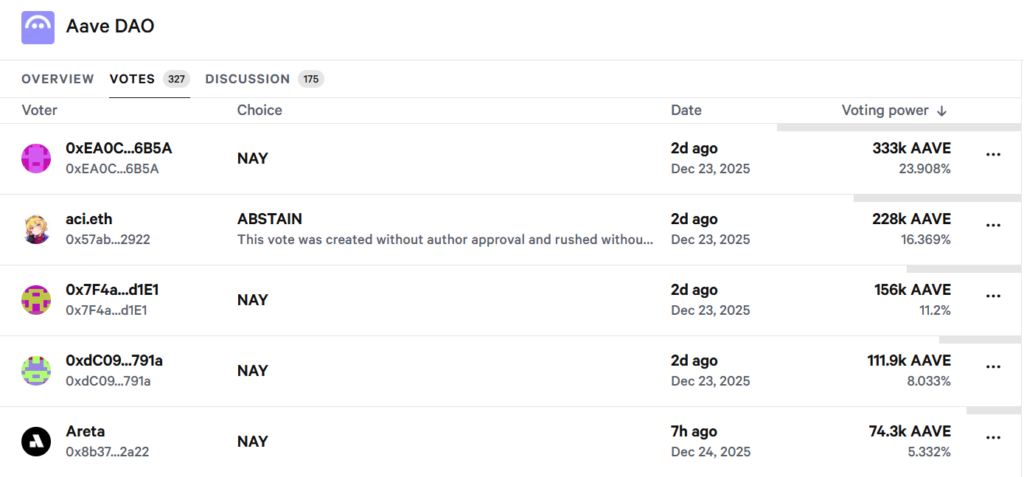
Samuel McCulloch of USD.ai also weighed in on the dispute. He described the vote as poorly balanced because of the concentration of voting power within the DAO. Snapshot data shows that a small group of wallets controls a large share of the total vote.
The top three voters account for more than 58% of voting power. One wallet alone controls 27.06%, equal to about 333,000 AAVE, while the second-largest voter holds 16.369%, or roughly 228,000 tokens.
While governance concerns dominated the discussion, market data showed continued weakness. AAVE was trading at $147.90 at press time, with a 24-hour trading volume of $404.27 million and a market cap of $2.26 billion. The price fell 1.69% over the past day and remains below the 200-day simple moving average.
Recent performance has also remained uneven. Only 14 of the past 30 days closed in positive territory, and the token is trading about 78% below its all-time high. Sentiment remains bearish, with the Fear and Greed Index at 24, signaling extreme fear.
Maximize your Cointribune experience with our "Read to Earn" program! For every article you read, earn points and access exclusive rewards. Sign up now and start earning benefits.
