Vitalik Buterin’s Warning: EU Lawmakers Must Target Algorithms, Not Innovation

Vitalik Buterin just threw a wrench into Europe's digital lawmaking machine. The Ethereum co-founder isn't mincing words: regulators are aiming at the wrong target.
### The Core Argument: Code vs. Creativity
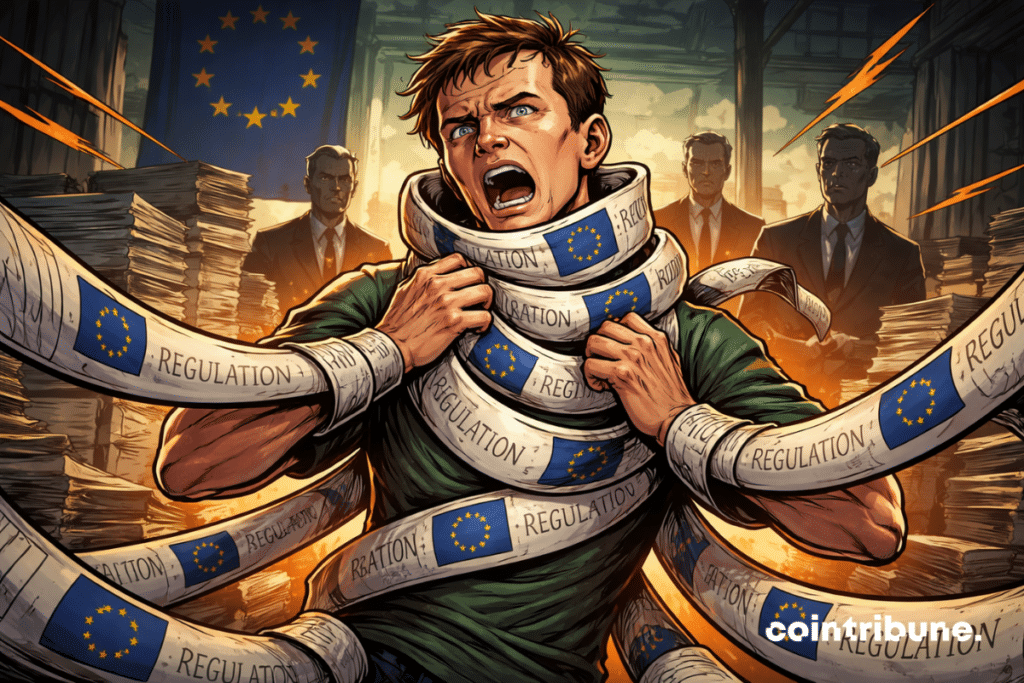
Buterin's plea cuts through the regulatory noise. His message to Brussels? Focus on the automated systems—the algorithms that govern platforms—not the foundational ideas powering decentralized tech. Slowing down code is one thing; stifling human ingenuity is a fatal error for a continent desperate to lead in Web3.
### Why This Matters for Crypto's Future
This isn't abstract philosophy. It's a direct challenge to the EU's approach to governing digital spaces. Over-regulate the underlying protocols, and you risk exporting the next generation of tech talent—along with their taxable revenue—to more hospitable shores. It's a classic case of lawmakers trying to put a speed governor on a rocket ship.
### The Finance Angle: A Cynical Take
Of course, watching traditional finance scramble to understand decentralized systems while simultaneously trying to regulate them is its own form of entertainment—like a horse-drawn carriage commission trying to draft rules for air traffic control.
Buterin's intervention is a timely reminder. The real battle isn't about controlling the idea of a decentralized internet; it's about responsibly governing the automated tools that will build it. Get that balance wrong, and Europe's digital future will be written elsewhere.
 Read us on Google News
In brief
- Vitalik Buterin accuses the EU, through the Digital Services Act (DSA), of pushing toward a “space-less” internet where any deviation is closely monitored.
- He argues that the real danger isn’t the existence of controversial ideas, but their massive amplification by algorithms.
- This control-driven approach strengthens the case for privacy and could revive interest in privacy coins like Monero and Zcash.
An “internet without gaps”: what the DSA really changes according to Vitalik
The DSA does not target a handful of giants; it targets the ecosystem, including services related to cryptocurrencies. Any platform that reaches European users falls within scope. Small, large, European or not: no one is completely “out of scope.” This logic has an obvious virtue: closing backdoors that some used to declare themselves irresponsible.
But this architecture also has a side effect: it creates diffuse, constant regulatory pressure, like background noise. Obligations adjust according to size and risk, of course. But the philosophy remains the same: there must be no gray area.
That’s where the “no-space” label is born, as Vitalik points out. No unregulated space. No digital nooks where crypto content judged problematic could sneak in. The stated intention is not total censorship. The core of the text rather talks about risk assessments, transparency, design choices. But in practice, the message sent to platforms can be summed up brutally: “let nothing through.”
For Buterin, it’s not the existence of the marginal that’s the problem, it’s its industrial prominence.
Buterin: the real danger is algorithms pushing poison on a large scale
Buterin’s argument is almost clinical: a free society must not seek to eradicate all ideas it deems harmful. In the same logic, he who defends the idea of lightening and clarifying Ethereum to approach a true “trustlessness” insists on one point: instead of wanting to erase everything, we must break the mechanisms that empower these contents.
For him, the priority is to prevent these ideas from becoming dominant through algorithmic mechanics. In other words, you do not fight a rumor by deleting it everywhere; you fight the machine that turns it into a trend.
And that’s where the criticism becomes political. “Zero tolerance” naturally slopes toward excess. When the goal becomes “no loopholes,” the tool becomes surveillance. Then technocratic enforcement. Then dependence on arbitrators. And suddenly, a public debate is treated like a gas leak.
Buterin speaks of pluralism, at heart. The contradiction is uncomfortable, but it is structuring. Wanting to eliminate it risks creating a smooth… and fragile society. In the crypto world, this fragility has a cost: once a framework becomes too rigid, innovation does not die; it moves.
And when regulation pushes for more control, an old crypto reflex resurfaces: privacy protection.
Privacy, data, “privacy coins”: a possible boomerang effect
In this context, the “privacy-first” narrative gains strength. Not necessarily as a speculative promise, but rather as a philosophical reminder: digital intimacy is not a luxury, it’s a LAYER of security. Users do not read all laws, but they understand very well when the air becomes heavy.
The debate has revived interest in privacy coins like Monero or Zcash. Not because everyone wants to become invisible. But because many discover a simple truth: the more you monitor, the more you store. And the more you store, the more you expose. Data is a flammable material. It always ends up burning somewhere.
Maximize your Cointribune experience with our "Read to Earn" program! For every article you read, earn points and access exclusive rewards. Sign up now and start earning benefits.
