Peter Schiff Declares Bitcoin Disqualifying Strategy From S&P 500 — Is He Right?

Gold bug versus digital gold—the feud reignites with a fresh salvo against crypto's flagship asset.
Schiff's S&P 500 Smackdown
Vocal Bitcoin critic Peter Schiff just doubled down, claiming the cryptocurrency represents a 'disqualifying strategy' for the storied S&P 500 index. His argument hinges on volatility and a perceived lack of fundamental value—classic refrains from the old-guard finance choir. It's the kind of take that gets traditional portfolio managers nodding sagely over their Bloomberg terminals.
The Counter-Argument: Digital Disruption
Meanwhile, in the other corner, crypto advocates see an asset class maturing at warp speed. They point to institutional adoption, the evolution of regulatory frameworks, and Bitcoin's hardening role as a non-sovereign store of value. For them, exclusion isn't a disqualification—it's the index showing its age, like a fund manager who still thinks 'the blockchain' is a new type of bicycle lock.
A Provocative Closing Bell
So, who's winning the narrative? Schiff's warning plays well in a world of 60/40 portfolios and CAPE ratios. But in a financial landscape being rewritten by code, dismissing the asset that started it all might be the riskier strategy. After all, the S&P didn't add tech stocks until they'd already reshaped the economy—a costly lag that today's index committees are keen not to repeat. Sometimes, the most 'prudent' strategy is just a fancy word for missing the boat.
Even in a Bullish Year, Some S&P 500 Stocks Crashed
The comments arrive against the backdrop of a strong year for the broader U.S. equity market.
The S&P 500 ended 2025 up about 17.3%, following gains of 23.3% in 2024 and 24.2% in 2023.
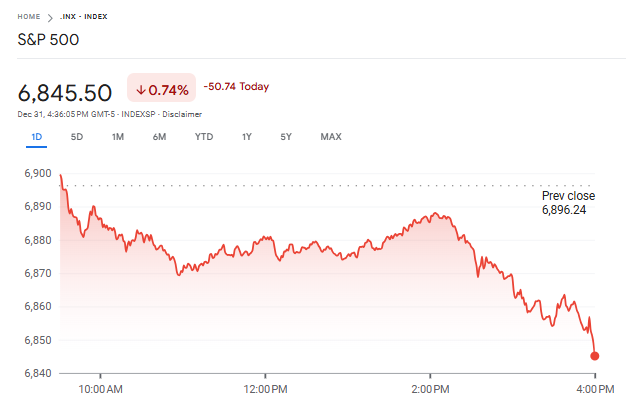
While the index as a whole posted solid returns, performance within it was uneven. Several large-cap stocks suffered steep losses due to company-specific setbacks and shifting market conditions.
Fiserv was the worst-performing stock in the S&P 500 in 2025, finishing the year down roughly 70% after missing earnings expectations, cutting guidance, and facing client complaints.
The Trade Desk followed closely with a decline of around 68%, pressured by slower revenue growth, rising competition from larger technology firms, and executive departures.

Sarepta Therapeutics fell more than 80% after patient deaths and regulatory warnings related to its gene therapy treatments.
Other laggards included Deckers Outdoor, Gartner, and Lululemon Athletica, all of which lost more than 50% during the year amid weaker forecasts, restructuring efforts, or prolonged growth challenges.
MSTR’s Bitcoin Strategy Delivers Gains, But Stock Suffers in 2025
Strategy, which trades under the ticker MSTR, is not a member of the S&P 500, but its 2025 performance drew comparisons because of its scale and volatility.
The stock began the year trading near $300 and surged in the first quarter, gaining about 50% as bitcoin prices climbed, as it reached an annual high of $457.22 on July 16, 2025.
That rally reversed sharply in the second half of the year as Bitcoin pulled back and broader risk sentiment shifted. By late September, the stock had erased its year-to-date gains.
The decline deepened into the fourth quarter, and on December 31, MSTR hit an annual low of $151.42 before closing slightly higher at $151.95. The stock ended the year down about 49.35%, making it the worst performer in the Nasdaq-100 for 2025.
Despite the stock’s slide, Strategy continued to expand its Bitcoin holdings. As of late December, the company held 672,497 BTC, acquired at an average cost of about $75,000 per coin.
At current prices NEAR $87,800, those holdings are valued at roughly $59 billion, leaving the firm with an unrealized gain of about 17%.
The company disclosed another purchase on December 29, buying 1,229 bitcoin for approximately $108.8 million using proceeds from its ongoing at-the-market stock offering.
Executive chairman Michael Saylor said the firm’s Bitcoin yield for 2025 stood at 23.2%.
Bitcoin or Business Model? The Real Barrier to Strategy’s S&P 500 Entry
Bitcoin itself is not disqualifying Strategy from the S&P 500, but the way the company is structured around the asset remains a central issue.
Strategy met the index’s Core quantitative requirements in late 2025, including market capitalization and profitability, after reporting large net income driven by Bitcoin gains.
However, inclusion in the S&P 500 is not automatic, as the final decisions rest with a committee that prioritizes operating businesses over investment-style vehicles.
The committee has shown reluctance to add companies whose valuation is dominated by treasury assets rather than products or services.
Analysts argue that Strategy now resembles a Bitcoin proxy, similar to a closed-end fund, which is an ineligible structure under index rules.
This differs from firms like Tesla or Block, which hold Bitcoin but generate revenue from diverse operations.
Historically, steep stock declines do not disqualify companies, as many S&P 500 members have recovered from major drawdowns.
Even sharp price increases do not ensure entry, as the committee evaluates sustainability, volatility, and business fundamentals before listing.
