Nick Shirley’s $9M Base Creator Coin Plunges 67% in Hours – A Brutal Lesson in ’It Just Didn’t Work’

Another creator token experiment hits the rocks—hard. The latest casualty on Base, a much-hyped project tied to a prominent figure, just demonstrated the brutal efficiency of crypto markets in separating hype from substance.
The Numbers Tell the Story
Talk about a rug pull of confidence. A valuation that once flirted with the $9 million mark evaporated in a matter of hours, leaving a 67% crater in its wake. That's not a dip; that's a collapse. It's the kind of volatility that turns 'hodlers' into bag-holders before they can even refresh their portfolio tracker.
Why These Experiments Keep Failing
The pattern is getting familiar. A creator's audience, no matter how loyal, isn't a substitute for sustainable tokenomics or real utility. Liquidity dries up, the initial speculative frenzy fades, and you're left with a digital asset whose primary use case is serving as a cautionary tale. It's the financial equivalent of building a castle on a foundation of tweets and goodwill—eventually, the tide comes in.
Separating Signal from Noise
For every legitimate innovation in decentralized social finance, there are a dozen quick flips masquerading as community building. This crash is a stark reminder: in crypto, traction isn't just about follower counts. It's about building something that lasts beyond the first sell-off. The market's verdict here was swift and unambiguous—a multi-million dollar 'nope.'
Look, the dream of creator economies on-chain is far from dead. But this? This is what happens when the financial engineering gets ahead of the actual value creation. Sometimes the most honest thing a project can do is admit what the charts already scream: it just didn't work. Consider it a $9 million masterclass in market discipline—the hard way.
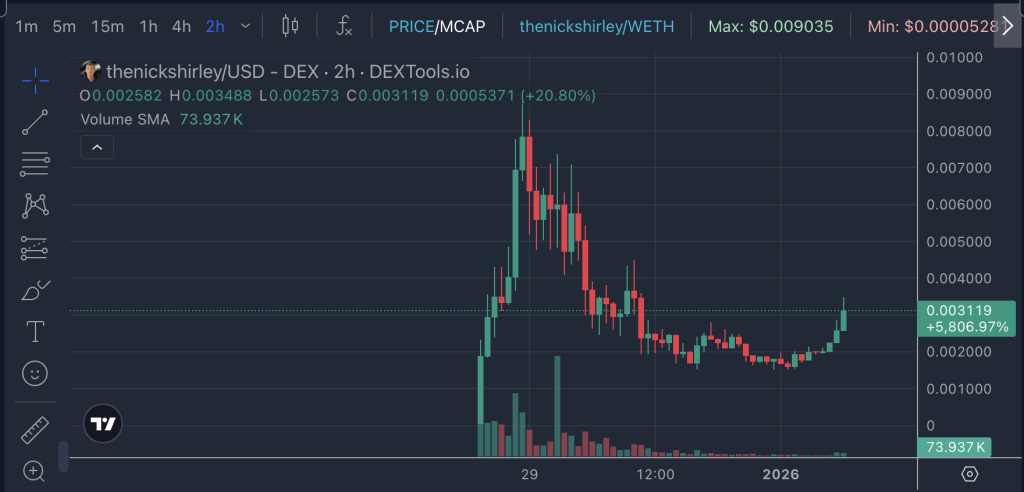 Source: Dextool
Shirley’s Creator Token Surged on Hype, Then Lost Momentum
Shirley’s token, traded under the ticker $THENICKSHIRLEY, emerged in late 2025 after a 42-minute investigative video he published went viral across X, drawing hundreds of millions of views and attention from high-profile figures.
 Here is the full 42 minutes of my crew and I exposing Minnesota fraud, this might be my most important work yet. We uncovered over $110,000,000 in ONE day. Like it and share it around like wildfire! Its time to hold these corrupt politicians and fraudsters accountable
We ALL… pic.twitter.com/E3Penx2o7a
The video, centered on alleged childcare fraud in Minnesota, pushed Shirley into the center of a political and media storm after the claims were amplified by Elon Musk and figures tied to the TRUMP administration.
The allegations later became part of broader discussions cited when federal officials announced a freeze on childcare funds to Minnesota.
Against that backdrop, Shirley’s creator token was promoted as a real-world test of decentralized content monetization.
The initial surge was swift as the trading activity drove the token’s fully diluted valuation to roughly $9 million, with Coinbase CEO Brian Armstrong publicly praising the launch as an example of on-chain creator monetization.
Let’s go – good case study in how content monetizes better on Base vs other platforms.
More examples coming soon. Which top creator should we chat with next? https://t.co/G092fZ0m4j
However, the rally faded almost as quickly as it began. Within days, the token had dropped more than 60%, with most trading volume coming from existing on-chain traders rather than new users onboarding to Base or Zora.
Despite the price decline, on-chain data showed that Shirley earned an estimated $41,600 to $65,000 in creator royalties tied to trading activity.
Critics argue that this outcome highlights a structural imbalance, where creators and early traders benefit from short-term speculation while broader adoption fails to materialize.
Several traders described the episode as a missed opportunity for Base and Zora to convert viral attention into sustained user growth.
One of the most widely shared critiques came from a trader and content creator known as notthreadguy, who argued in a video that Shirley’s launch represented the strongest possible test case for creator coins and still failed to show durable demand.
He pointed to the lack of follow-through from platforms and the absence of meaningful new user onboarding, noting that profits and losses were largely confined to speculative traders already active on-chain.
Had a great chat today with @notthreadguy – lots of good ideas
Thank you for the thoughts https://t.co/cWNr80ZxCF
Additionally, Coinbase CEO Brian Armstrong acknowledged having a “chat” with notthreadguy.
Creator Coins Cool as Base Pushes Deeper Into SocialFi
The backlash landed amid broader frustration with creator-focused experiments on Base.
Other Zora-linked tokens have followed similar patterns, marked by sharp price spikes followed by rapid declines and thin liquidity.
A separate Solana-based meme coin, $LEARING, created by third parties to capitalize on a spelling error spotted in Shirley’s video, briefly reached a market capitalization above $3.3 million before also fading.
The episode comes as Base continues to position itself as a hub for decentralized social applications, following earlier experiments such as Friend.tech and newer platforms like Farcaster and Zora.
Industry forecasts project the SocialFi sector could exceed $10 billion by 2033, yet user retention has remained uneven.

Friend.tech, often cited as an early success, saw daily active users peak NEAR 80,000 before falling below 10,000.
