Starknet Mainnet Halts Again: Ethereum’s L2 Grinds to Standstill in Latest 2+ Hour Outage

Another day, another Starknet mainnet halt. The Ethereum L2 network froze solid for over two hours in its latest outage—raising familiar questions about scalability promises versus operational reality.
The Sequence Stops
Transactions stalled. Blocks stopped finalizing. For users and developers, the network simply went quiet. It's the same story with a different timestamp: a critical component fails, and the entire sequencer grinds to a halt.
Behind the Freeze
While the root cause specifics are under wraps, the pattern is clear. These aren't growing pains—they're systemic stumbles. The tech is brilliant in theory, but in practice? It keeps tripping over its own feet. Every minute of downtime isn't just an inconvenience; it's eroded trust and a stark reminder that 'decentralization' often has a single point of failure.
The Scaling Paradox
Here's the ironic twist: Starknet exists to scale Ethereum, to make it faster and cheaper. But when the scaling solution itself goes down, it doesn't just fail—it highlights the very fragility it was built to solve. It's like building a bullet train that derails if someone sneezes on the tracks.
The Finance Angle (With a Jab)
For the degens and traders, it's a familiar headache—assets locked, positions stuck, opportunities missed. For the suits in traditional finance peeking over the crypto fence? It's the perfect excuse to mutter 'amateur hour' and pour another scotch. Nothing says 'institutional-grade infrastructure' like an unplanned two-hour nap in the middle of a trading day.
Starknet will reboot. The post-mortem will be published. The team will vow it won't happen again. But until these outages stop being a recurring headline, the gap between L2 ambition and L2 execution remains a chasm—and everyone's watching to see what falls in next.
 (@Starknet) January 5, 2026
No immediate explanation was given for the cause of the outage. At the time of the initial update, block production had stalled for just over two hours, leaving users unable to submit or finalize transactions.
Despite Strong Metrics, Starknet Halt Stops All On-Chain Activity
On-chain data from Starknet’s block explorer showed the network had processed more than 264 million transactions since launch and supported over 56,000 active accounts, with average transaction fees sitting below one cent.
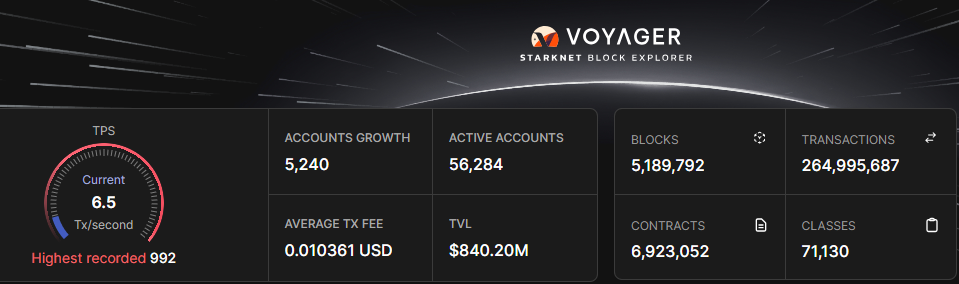
Total value locked stood at roughly $840 million. Despite these metrics, the halt effectively paused all activity across decentralized applications, wallets, and smart contracts during the downtime.
The explorer later indicated that block production had resumed, with new blocks appearing minutes after the incident was acknowledged publicly.

Starknet is designed to batch transactions off-chain and submit cryptographic proofs to Ethereum, allowing it to scale decentralized finance, gaming, and other smart contract use cases while relying on Ethereum for settlement and security.
 Starknet, Zcash, and Dash post firm gains as selective rotation favors tokens with active usage, liquidity, and identifiable drivers.#altcoin #zcash #zechttps://t.co/EKHTVvlCSY
The network has also positioned itself as a bridge for Bitcoin-related decentralized finance, promoting what it calls a BTCFi expansion within the Ethereum ecosystem.
The latest outage interrupted these ambitions, at least temporarily, as developers and users waited for normal operations to resume.
The disruption follows a difficult year for the network. In September 2025, Starknet experienced a far more severe incident after deploying a major upgrade known as Grinta, version 0.14.0.
That update, intended to advance decentralization by introducing multiple sequencers, triggered an extended halt in block production that lasted approximately nine hours.
During that episode, the network required two chain reorganizations, rolling back around an hour of activity and forcing users to resubmit transactions.
Starknet Outage Adds to Growing Pattern of Network Interruptions
A post-mortem published after the September outage traced the failure to a combination of factors.
Different sequencers were operating with inconsistent views of Ethereum due to issues with RPC providers, which disrupted block proposals.
A separate software bug in the component responsible for updating Starknet’s state compounded the problem when handling reverted transactions, ultimately leading the team to manually halt the chain to preserve correctness.
In April 2024, Starknet suffered a four-hour outage after a rounding error triggered block reorganizations, filling transaction capacity before developers cleared the backlog and restored normal network operations.
Starknet, an Ethereum Layer-2 protocol, is opening up about Thursday's block outage – but what did they say caused it?#Starknet #STRK #L2https://t.co/xorxselGX9
— Cryptonews.com (@cryptonews) April 5, 2024While the latest halt appears shorter and less severe than the September incident, it adds to a pattern of interruptions during Starknet’s transition toward a more decentralized architecture.
Such halts typically result in delayed or failed transactions, temporary inaccessibility of funds and services, and downtime for applications built on the network.
In previous incidents, some centralized exchanges temporarily suspended STRK deposits and withdrawals as a precaution, although trading often continued internally.
Market reaction to the latest outage was muted. STRK was trading around $0.089, up about 1.3% over the past 24 hours, with daily trading volume rising more than 38% to roughly $63.7 million.
The token remains sharply below its early-2024 peak above $4, reflecting broader market conditions and lingering concerns around supply and network reliability rather than a single event.
