CZ-Backed YZi Labs Blasts CEA’s ’Poison Pill’ as Boardroom War Heats Up

Boardroom battles aren't just for suits and ties anymore—they've gone digital, and the stakes are crypto-high.
The Inside Scoop on the 'Poison Pill'
Forget hostile takeovers from Wall Street; the new frontier is in the blockchain boardroom. A major governance clash is unfolding, pitting a heavyweight-backed development lab against a regulatory-minded association. The core of the conflict? A defensive tactic so aggressive it's being called a 'poison pill'—a move designed to make any unwanted influence prohibitively expensive or complex. It's a classic corporate defense, but applied to a decentralized world where the rules are still being written in real-time.
Why This Fight Matters for Your Portfolio
This isn't just internal politics. Governance wars can freeze development, scare off partners, and crater token value. When the people building the tech are at war with the people setting the rules, progress grinds to a halt. Investors are left holding the bag, watching from the sidelines as tweets and blog posts replace product updates. It's the ultimate test of whether these decentralized projects can handle real-world power struggles without centralizing control or collapsing into chaos.
The fallout from this clash will be a litmus test for project maturity. Can decentralized governance survive a bare-knuckle fight? Or will it prove to be just another selling point that fades when the real money and influence hit the table? One cynical take: it's almost comforting to see crypto founders rediscovering the oldest trick in the finance book—using bylaws as a weapon. Some traditions, it seems, are truly blockchain-agnostic.
YZi Labs Calls Out CEA Over “Stockholder-Unfriendly” Moves
In a statement posted on X, YZi Labs said it was “disappointed” by what it described as stockholder-unfriendly actions designed to entrench CEA’s current board rather than protect investor interests.
The investment firm, which holds roughly 5% of CEA’s outstanding shares, argued that the new measures restrict shareholders’ ability to act by written consent and add procedural hurdles that go beyond Nevada law.
https://t.co/HAmsN1pG52
— YZi Labs (@yzilabs) January 7, 2026The conflict marks a dramatic reversal from the Optimism that surrounded CEA just months ago.
In mid-2025, the company completed a $500 million private investment in public equity deal backed by YZi Labs and 10X Capital, pivoting away from vape manufacturing to become a BNB-focused digital asset treasury.
 @10XCapitalUSA launches $BNB treasury company backed by @YZiLabs targeting US public listing as corporate adoption explodes beyond Bitcoin-only strategies into BNB ecosystem.#BNB #Treasuryhttps://t.co/OaYEWjhoGV
Shares surged more than 600% in July as the strategy was unveiled, positioning CEA as the largest publicly traded BNB holder in the U.S.
That momentum has since faded.
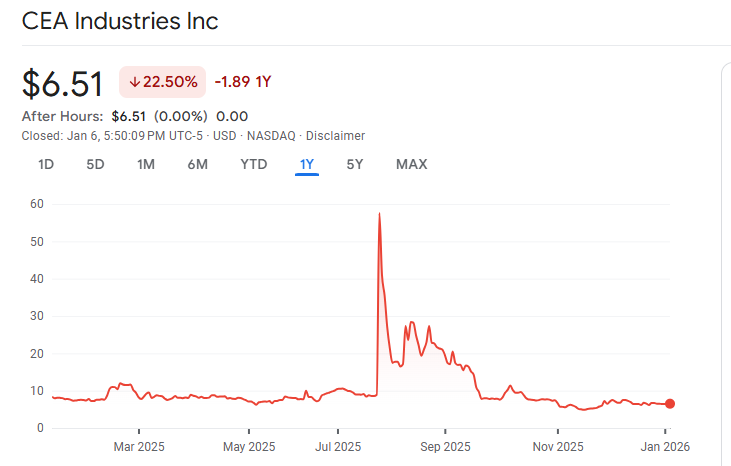
CEA’s stock has fallen more than 90% from its peak, closing NEAR $6.50 this week, even as BNB rose roughly 38% over the past six months.
Poison Pill Deepens Standoff Between YZi Labs and CEA Board
Tensions boiled over in early December when YZi Labs filed a preliminary Schedule 14A with the U.S. Securities and Exchange Commission, launching a consent solicitation aimed at overhauling CEA’s board.
 CZ-backed YZi Labs targets BNC as shares plunge 89%, citing widening NAV discount and weak governance while pushing for board control.#BNC #YziLabshttps://t.co/kD2ACxah2q
The filing seeks to expand the board, unwind bylaw changes adopted after July, and install a new slate of directors nominated by YZi Labs through written shareholder consent, without waiting for a formal meeting.
CEA’s board responded by adopting a limited-duration stockholder rights plan, commonly known as a poison pill, and amending its bylaws.
Under the plan, if any person or group acquires 15% or more of the company’s shares without board approval, other shareholders WOULD be allowed to purchase additional shares at a 50% discount.
This effectively dilutes the would-be acquirer and makes a takeover prohibitively expensive.
YZi Labs said these moves signal that the board lacks shareholder support and is prioritizing self-preservation.
The firm also raised concerns about the delay of CEA’s 2025 annual meeting beyond its December 17 anniversary date, warning against what it called further “manipulative behavior” around meeting scheduling or director nominations.
Beyond governance mechanics, YZi Labs directly challenged CEA’s public statements about its digital asset treasury strategy.
The firm rejected the company’s claim that it had never considered alternative tokens to BNB, pointing to comments made by CEO David Namdar at a November 2025 industry conference where he acknowledged discussions around other assets, including Solana.
YZi Labs also flagged potential conflicts of interest, citing the involvement of Namdar and board member Hans Thomas in promoting other crypto treasury ventures while serving in leadership roles at CEA.
In its filings, YZi Labs accused the board of operational failures, including delayed regulatory filings, limited investor communications, and a lack of regular reporting on net asset value and BNB accumulation.
The dispute is now set to hinge on the delayed 2025 annual meeting, which YZi Labs has described as a critical venue for shareholders to decide the company’s future leadership and strategic direction.
CEA has not yet issued a detailed public response to the consent solicitation.
