70 Top Economists Sound Alarm: EU Must Launch Digital Euro Now to Beat Private Stablecoins

Forget waiting on the sidelines—the race for Europe's financial future just got a starting gun. A bloc of 70 heavyweight economists is demanding the EU stop dithering and launch a public digital euro. Their argument? It's the only way to stop private stablecoins from eating the central bank's lunch.
The Sovereignty Stakes
This isn't just about payments. It's about control. The economists warn that letting corporate-backed stablecoins dominate the digital currency space hands over a chunk of monetary sovereignty. A public digital euro, they argue, keeps the power—and the data—where it belongs: with the people and their institutions.
Cutting Out the Middleman
Imagine sending euros across borders instantly, without the usual fees and friction. That's the promise. A central bank digital currency (CBDC) bypasses the traditional banking spaghetti, offering a direct line from the issuer to your digital wallet. It's efficiency on a continental scale.
The Trust Factor
While private stablecoins promise innovation, they come with a balance sheet and a boardroom. The economists point to the inherent stability of a state-backed alternative. In a crisis, would you rather trust a algorithm and a reserve audit, or the full faith and credit of the European Central Bank?
The clock is ticking. With every month of delay, private alternatives dig in deeper. The call from these 70 experts is clear: build it, or watch the foundation of European finance get outsourced. After all, what's a central bank in the digital age if it doesn't issue a digital currency? Just another costly intermediary in a suit.
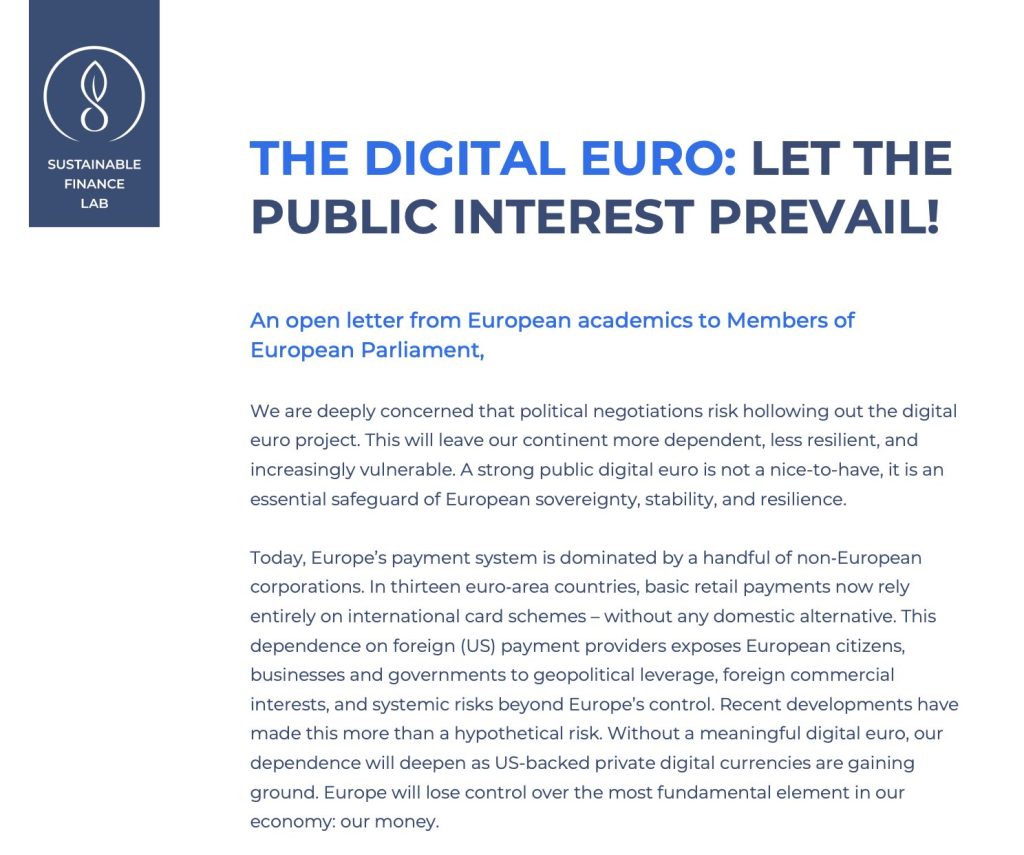 Open Letter to MEP. | Source: Sustainable Finance Lab
Strong Design Features Essential for Digital Euro Success
The signatories, including former central bank governors and prominent economists such as Thomas Piketty and Paul De Grauwe, demand three Core features.
The digital euro must function as “the backbone of a sovereign, resilient European payment infrastructure based on domestic providers adopting the highest privacy standards,” serve as “public digital money accessible to all Europeans, supporting financial inclusion,” and offer “a credible store of value through a generous and gradually rising holding limit.“
Without these elements, the economists warn that the project will fail.
“If a large part of European companies is excluded or allowed to refuse it, or if holding limits remain so low that citizens cannot use it as a serious store of value, then the digital euro will fail to realise its potential,” they write.
The letter describes the stakes in stark terms, asking whether Europeans will “assert control over their money in the digital age, or do we allow others to control it for us?“
ECB Officials Position Digital Euro Alongside Safe Asset Expansion
ECB Executive Board member Philip Lane reinforced the strategic case in a January 9 speech to the Danish Economic Society, framing the digital euro within broader efforts to strengthen Europe’s financial architecture.
Lane argued that structural changes, including geopolitical shifts, digitalization, and climate change, represent common shocks best handled through monetary union, with the digital euro providing “retail central bank money in digital form” as transaction systems evolve.

ECB Philip Lane. Source: CEPR
Lane also addressed Europe’s shortage of SAFE assets, noting that the German Bund alone cannot meet global demand for euro-denominated securities.
He outlined potential solutions, including expanded common bonds for European public goods and the “blue bond/red bond” reform, where member states WOULD ring-fence tax revenues to back jointly issued securities.
“The shared pay-off would be the reduction in debt servicing costs generated by the safe asset services provided by an expanded stock of common debt,” Lane said.
Timeline Advances as Political Negotiations Continue
Technical preparations are nearing completion following the ECB’s October decision to MOVE into the readiness phase.
ECB President Christine Lagarde confirmed last month that “we have done our work, we have carried the water,” placing responsibility on EU institutions to finalize legislation.
Board member Piero Cipollone previously indicated that pilot transactions could begin mid-2027, with the first issuance possible in 2029 if lawmakers approve the framework next year.
Last month, the EU Council also agreed on its negotiating position, establishing a framework that includes both online and offline payment options.
The offline version would allow device-to-device transactions without internet access, offering privacy comparable to cash for low-value payments while maintaining anti-money laundering compliance for wallet funding.
 ECB President Christine Lagarde said that the digital euro is technically ready and is now awaiting legislative approval.#ECB #DigitalEuro #EUStablecoinhttps://t.co/4cdYV6UdSJ
Lagarde emphasized that the digital euro would complement physical currency under Europe’s Markets in Crypto-Assets Regulation, describing MiCA-compliant stablecoins as “an alternative FORM of payment” that can be “.”
Public acceptance remains uncertain, with recent ECB surveys showing many Europeans see limited need for the new payment option despite official assurances.
