Bitwise CIO Calls Bitcoin 401(k) Fears ’Ridiculous’ – Says It’s ’Less Volatile Than Nvidia’

Forget what the old-guard financial advisors are whispering. The argument against including Bitcoin in retirement portfolios just got publicly dismantled.
The Volatility Smokescreen
Wall Street's favorite scare tactic—cryptocurrency's wild price swings—doesn't hold up under a simple comparison. Look at Nvidia, the darling of the AI revolution and a staple in countless retirement funds. Its stock chart looks like a mountain range drawn by a toddler. Measured side-by-side, Bitcoin's recent trajectory has been a smoother ride. So why the double standard? It’s easier to fear the new than to question the existing, underperforming assets clogging up your 401(k).
A Prudent Allocation, Not a Gamble
This isn't a call to bet your entire nest egg. It's about a strategic, single-digit percentage allocation. In an era where traditional finance offers near-zero real returns, a small exposure to the highest-performing asset class of the last decade isn't reckless—it's rational portfolio management. The real risk isn't volatility; it's missing out on the digital transformation of money itself while your savings are slowly eroded by inflation and mediocre fund fees.
The narrative is shifting. The question is no longer *if* digital assets belong in a balanced portfolio, but *how much*. Waiting for 'less volatility' is just a polite way of saying you'll buy at all-time highs—a classic move perfected by the same institutions now urging caution. Maybe their fear isn't for your retirement, but for their own irrelevance.
Bitcoin Was Less Volatile Than Nvidia, Hougan Says
At the center of Hougan’s argument is a comparison he says regulators and plan administrators often avoid.
Over the past year, Bitcoin has been less volatile than Nvidia, one of the most widely held stocks in US retirement portfolios.
Nvidia shares fell to around $94 in April 2025 before surging past $207 by October, a MOVE of roughly 120%. Bitcoin, by contrast, traded between about $76,000 and $126,080 over the same period, a swing of around 65%.
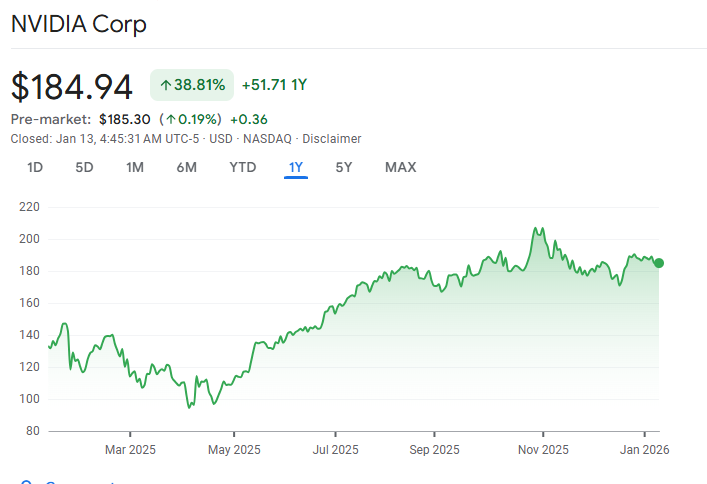
Despite that difference, Hougan noted, there are no calls to ban 401(k) providers from offering Nvidia stock.
“This is just another asset,” Hougan said during the interview, adding that while Bitcoin clearly carries risk, that risk is often overstated relative to familiar equities.
His remarks directly challenge a long-standing narrative that crypto volatility alone should disqualify it from retirement plans. The debate has gained urgency following a series of regulatory shifts in the United States.
Last August, President TRUMP issued an executive order directing the Department of Labor to reconsider limiting the inclusion of alternative assets in defined-contribution plans, which has again made cryptocurrencies a possibility in 401(k)s.
The Employee Benefits Security Administration of the Labor Department had previously canceled 2022 guidance encouraging plan fiduciaries to be extremely cautious with crypto and adopted a more neutral position on it, neither approving nor discouraging its inclusion.
Bitcoin Access in Retirement Plans Remains Limited
Despite those changes, access to Bitcoin in retirement accounts remains limited. For most workers, exposure is only possible through self-directed brokerage accounts, where the investment decision fall squarely on the individual.
Only a small number of providers, including Fidelity and ForUsAll, currently offer pathways to Bitcoin exposure, often through spot Bitcoin ETFs. Large firms such as Vanguard have stayed on the sidelines.
Warren has been one of the most vocal critics of expanding crypto’s role in retirement savings.
In an open letter published Monday, she warned that allowing crypto into 401(k)s could expose workers to higher fees, market manipulation, and sharp price swings that undermine retirement security.
She argued that for many Americans, retirement accounts are a financial lifeline rather than a place for speculative bets.
Warren has asked SEC Chair Paul Atkins to explain how the agency accounts for crypto volatility in valuations and whether it is studying manipulative practices in digital asset markets, with responses requested by Jan. 27.
 One of Paul Atkins' first priorities will be to decide whether exchange-traded funds tracking XRP and SOL can be approved#SEC #Regulationhttps://t.co/u1biilBDuh
Hougan acknowledged that widespread adoption will not happen overnight.
He said 401(k) providers are slow-moving institutions constrained by fiduciary risk and regulatory uncertainty, but he expects Bitcoin exposure to become normalized over time.
He pointed to increased institutional participation, particularly through spot Bitcoin ETFs, as a stabilizing force that has already reduced Bitcoin’s extreme volatility compared with earlier cycles.
Bitcoin’s price history still shows larger drawdowns than broad market indices like the S&P 500, which typically sees annualized volatility of around 15% to 20%.
