$540M Crypto Bloodbath: The Real Reasons Altcoins Are Getting Crushed

Crypto markets just got rocked by a half-billion dollar shakeout—and altcoins are taking the hardest hit.
The Domino Effect
When Bitcoin stumbles, alternative cryptocurrencies don't just fall—they plummet. Market sentiment turns toxic faster than a decentralized exchange rug pull.
Liquidation Cascade
Margin calls trigger forced selling, creating a vicious cycle that wipes out $540 million in market value. Leveraged positions unravel like poorly coded smart contracts.
Institutional Cold Feet
Big money gets skittish during volatility, pulling liquidity from riskier altcoin plays. They'll jump back in later claiming they 'always believed in the technology'—typical Wall Street timing.
This isn't the first crypto winter, and it won't be the last. Smart money sees these dips as buying opportunities while the weak hands panic-sell. The market always recovers—just ask anyone who survived 2018.
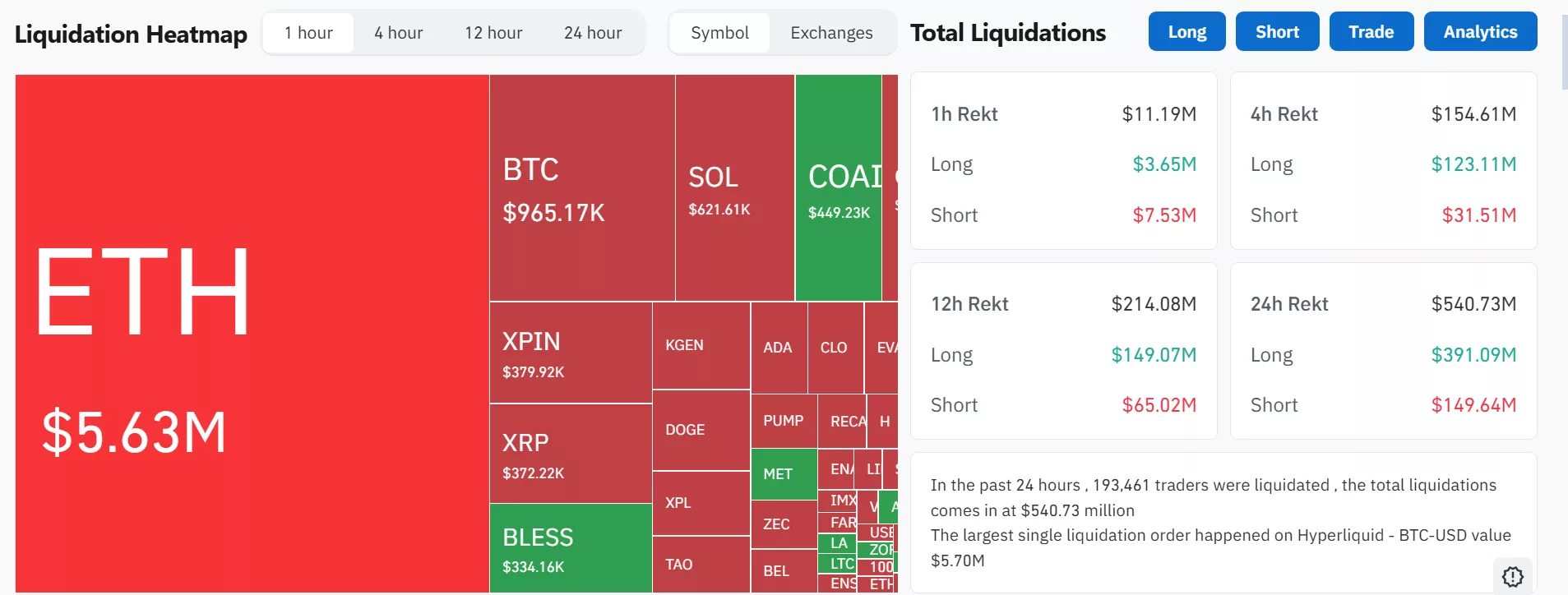 The crypto market crash has led to smaller altcoins and major tokens deepening losses | Source: CoinGlass
Smaller altcoins have been hit the hardest during this crypto market crash. ASTER has gone down more than 12% in the past 24 hours and has continued its week-long plunge by 30%. Similarly, ZEC has declined by more than 12% as well, however it sustained a 25% gradual rise throughout the week. LDO has reflected similar trends to ASTER, having dropped by 11.17% in the past day and falling nearly 20% in the past week.
Meanwhile, PENGU (PENGU) has lost about 3.8% of its value in the past day and 23.5% in the past week. Doge (DOGE) only dipped slightly by 1.8% in the past day, but has continued its 19% fall for the past seven days.
Major tokens seem more capable of staying afloat during the crypto market crash, but have seen losses deepening since the beginning of the week. In the past 24 hours, Bitcoin dropped slightly by 0.8% to the $111,407 level, while continuing its red streak by 8.4% within the past week. Ethereum is barely hanging on to the $4,000 level after declining by 1.3% within the past day and deepening its week-long drop by 6.4%.
The same can be said about BNB (BNB) and XRP, which have both gone down by 0.7% and 2.1% in the past day respectively. Both have also deepened their week-long downturns, with BNB falling by 7.9% and XRP by 12.7%.
Why is the crypto market crash continuing?
One key factor driving the current crypto market crash is the recent warning from G20’s risk watchdog, the Financial Stability Board. The regulatory body declared that there are “significant gaps” in rules enacted by countries that are attempting to regulate the rapidly developing crypto markets.
According to Reuters, the FSB believes the increasing integration of crypto markets into financial systems could potentially harm global financial stability. Although, the body does admit the risk is considered “limited at present” but have the possibility to rise as more and more institutional players warm up to crypto.
Such a stern warning may have spooked institutional investors, especially those that have recently just joined the crypto space.
Another main driver in the crypto market crash is the lasting residue from the massive Leveraged liquidations earlier this week. On Oct. 10, the crypto market lost more than $19 billion in crypto derivatives positions as prices dropped, triggering a wave of margin calls.
Even after the wave ended, the market appears to still be on edge, with data showing high put-option activity as whales short positions to hedge against potential crypto market crashes.
Meanwhile, macroeconomic and geopolitical tensions are intensifying the downturn. The ongoing U.S.-China trade standoff, marked by newly announced 100% tariffs on Chinese tech exports, has rattled global markets.
On Oct. 15, TRUMP announced that the U.S are currently in a “trade war” against China, as Xi Jinping also refuses to yield. This has prompted investors to shift away from risky assets and turn towards safer havens like gold and government bonds.As a result, cryptocurrencies are now vulnerable to heavy outflows. As liquidity dries up, even moderate sell pressure can cause outsized price swings, making recovery even more difficult for falling tokens.
Disclosure: This article does not represent investment advice. The content and materials featured on this page are for educational purposes only.
