Forget Palantir’s $10 Billion Army Deal—This News Just Changed Everything

Palantir just made a power move that overshadows even its massive defense contract—and it's happening in the boardroom, not the battlefield.
Data dominance meets corporate strategy
The real story isn't about government contracts—it's about how Palantir's tech is rewriting the rules of enterprise software. While Wall Street obsesses over defense dollars, the company is quietly locking down Fortune 500 clients at a pace that makes traditional SaaS vendors look like they're moving in slow motion.
Numbers don't lie—even when analysts do
That $10 billion figure suddenly seems almost conservative when you stack it against the scalability of commercial contracts. Palantir's platform isn't just selling software—it's selling institutional intelligence, and enterprises are paying premium rates to avoid becoming obsolete.
The bottom line: In a world where data is the new oil, Palantir isn't just drilling—it owns the refinery. And while traditional defense contractors are still counting government dollars, Palantir's commercial expansion proves that real growth happens when you stop asking for permission and start building what comes next. (Though let's be real—if this were a crypto project with these numbers, the SEC would've shut it down already.)
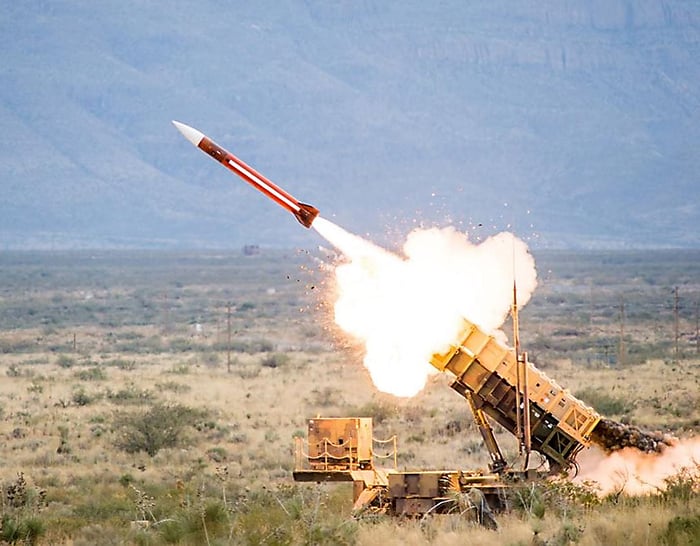
A Patriot missile produced by RTX launches. Image source: RTX.
Palantir vs. Raytheon
Lost in all the talk about Palantir's massive contract win earlier this month was an even bigger contract awarded to one of the defense contracting companies that Palantir is trying to supplant:(RTX -0.06%), the company formerly known as Raytheon.
On Aug. 1, the U.S. Defense Logistics Agency (DLA) announced, as just one of several contracts awarded by the Pentagon that day, a gigantic $50 billion contract awarded to RTX -- 5x the size of Palantir's win. This "umbrella" contract, said the Defense Department, encompasses "RTX systems and end-item production, spare parts, services, and other types of support."
Support for what, you may ask? Well, DoD didn't say it straight out in its official announcement exactly. But digging around for other sources discussing the same award, I quickly found the answer: Ordering on behalf of the Army, the DLA has secured RTX support for its Patriot air defense systems for the next 20 years.
Saluting Patriot
GovConWire.com, for example, specifically describes the RTX award as a "$50B umbrella contract for Patriot missiles." It further makes clear that the contract will run for an almost unprecedented 20-year term, and is not dependent upon renewal of "option periods."
Granted, to be 100% accurate, one must note that the "$50 billion" value is described as the "maximum" value the contract might reach. Still, assuming the Army does max out its allotted funds, that works out to $2.5 billion in annual Patriot revenue for RTX, every year, for the next 20 years.
And that's a huge deal.
How much is $2.5 billion worth?
All this being said, context is important -- especially for investors contemplating an investment in RTX stock.
RTX is, after all, a giant industrial company with multiple business segments, ranging from Collins Aerospace airplane parts to Pratt & Whitney airplane engines to Raytheon -- formerly the name of the entire company, but now just the name of the defense business. All of RTX produced sales of $80.7 billion last year, with revenue streams divided roughly equally among the three main business divisions. Raytheon in particular did sales of $26.7 billion last year -- so the company's big Patriot contract amounts to about 9.4% of Raytheon's total annual revenue.
Of the three divisions, Collins is by far RTX's most profitable unit, pulling down a fat 14.5% operating profit margin on its $28.3 billion in revenue. Pratt is the least profitable division at present, earning only a 7.1% margin, while Raytheon is somewhere in the middle, earning $0.097 per $1 in sales.
Investors can expect, therefore, that the new Patriot contract will earn RTX something on the order of $243 million annually, before taxes, at its current profit margin -- perhaps a bit more, if RTX generates cost efficiencies from producing Patriots at scale.
Is RTX stock a buy?
Now, $243 million is a lot of money, and no one's saying different. Still, investors need to realize that even $243 million annually is only about 4% of what RTX earned over the last 12 months. You also need to consider that RTX was already selling Patriots to the Army before this contract was awarded, so not all the $2.5 billion a year in Patriot revenue from the contract, nor all the $243 million in profit, is going to be new, incremental revenue and profit added onto what RTX was already making.
As a result -- and crazy as this sounds to say out loud -- I do not believe that even RTX's gigantic $50 billion Patriot win is going to noticeably increase the 8.7% long-term earnings growth rate that analysts polled by S&P Global Market Intelligence estimate for RTX. That's a shame, because at its current valuation of 33.5 times trailing earnings, RTX shares look far too expensive to buy with just a single-digit growth rate to support them.
The bottom line: $50 billion contract or no $50 billion contract, RTX stock remains a sell for me.
