Short-Term Bitcoin Holders Return To Losses Despite Elevated Price Levels – The Hidden Market Reality

Bitcoin's price sits at lofty heights—yet a chunk of its most recent buyers are already underwater. It's a classic crypto paradox: the headline number gleams, but the on-chain story reveals pockets of pain.
The Cost of Chasing Momentum
Short-term holders—those who bought within the last 155 days—are feeling the squeeze. Their aggregate cost basis has flipped from profit back into loss territory, a signal that recent price consolidation and volatility have wiped out their gains. This cohort is notoriously reactive; their average cost price now acts as a key resistance level the market must overcome to resume a sustained uptrend.
On-Chain Data Doesn't Lie
While speculators nurse losses, long-term holders continue to sit tight, their conviction unshaken. The divergence creates a tension beneath the surface of elevated spot prices. It’s a battle between impatient capital and diamond-handed conviction, with the latter group historically providing the market's stability floor.
A Necessary Market Cleansing?
This return to losses for the short-term crowd might just be the market's way of shaking out weak hands. Each cycle needs its momentum chasers to provide liquidity on the way up—and to absorb the volatility on the way to higher ground. Consider it the crypto ecosystem's ruthless, automated version of a margin call, just without the polite phone call from your broker.
So, while the portfolio statements of recent buyers might sting, this phase often sets the stage for the next leg up. After all, in finance, someone's 'market correction' is always someone else's 'investment thesis failing spectacularly.'

This deterioration is notable because it is occurring while Bitcoin’s price remains relatively elevated compared to previous cycle drawdowns, suggesting that stress is building beneath the surface rather than after a full capitulation.
Historically, periods where short-term holders operate at a loss often coincide with late-stage corrections or consolidation phases within broader market transitions. While this does not confirm a market bottom, it highlights fragility in near-term demand and reinforces the idea that bitcoin is at a critical inflection point as 2026 approaches.
Short-Term Holder Stress Signals a Market at a Crossroads
Recent on-chain observations suggest Bitcoin is entering a delicate phase where short-term holders are increasingly under strain. When newer market participants slip into losses, it often signals that price has moved faster than incoming demand can comfortably absorb. In past cycles, this condition has typically appeared near the later stages of corrections or during extended sideways phases, rather than at the start of DEEP bear markets.
What makes the current setup notable is Bitcoin’s proximity to the average acquisition price of short-term holders. This zone has historically acted as a psychological and behavioral battleground. When price hovers near this level, market reactions tend to intensify, as traders decide whether to cut losses or hold through uncertainty. The outcome often defines whether consolidation continues or volatility expands.
Importantly, the scale of losses remains moderate compared to historical capitulation events. Previous market resets, such as those seen in 2018 or mid-2022, were characterized by far deeper and more prolonged stress among short-term holders. The absence of similar extremes today suggests that, while sentiment is weak, the broader market structure has not yet broken down.
That said, persistent pressure on short-term holders reflects fragile near-term demand. If losses begin to narrow, it could signal stabilization and set the stage for a relief move. If they widen instead, downside moves are more likely to accelerate.
Bitcoin Consolidates Below $90K
Bitcoin price action on the 3-day chart shows a clear transition from trend expansion to consolidation following the sharp correction from the $120K–$125K region. After losing the 50-day and 100-day moving averages during the November breakdown, BTC accelerated lower before finding demand in the mid-$80K zone. Since then, price has stabilized and is now compressing just below $90K, suggesting that downside momentum has slowed materially.
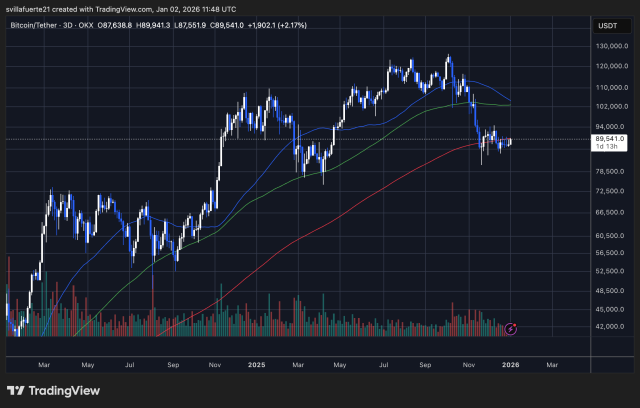
The current structure reflects a market in equilibrium rather than capitulation. Bitcoin is trading above the 200-day moving average, which continues to slope upward, preserving the broader bullish structure from a higher-timeframe perspective. However, the declining 50-day and 100-day averages overhead are acting as dynamic resistance, capping upside attempts and preventing a clean trend reversal for now.
Selling pressure peaked during the November decline, but recent candles show reduced volume, consistent with seller exhaustion rather than aggressive accumulation. This often precedes a range-bound phase where the market digests prior gains.
From a technical standpoint, holding the $85K–$88K region is critical. A sustained defense of this area keeps the consolidation intact and opens the door for a relief rally toward the $95K–$100K zone.
Conversely, a decisive loss of this support WOULD expose Bitcoin to a deeper retracement toward the 200-day average, shifting the short-term bias back to the downside.
Featured image from ChatGPT, chart from TradingView.com
