Philippines Cracks Down: Why Coinbase, Gemini and 50+ Crypto Platforms Got Blocked

The Philippines just slammed the door on more than 50 crypto exchanges, including giants Coinbase and Gemini. It's a regulatory shockwave rippling through the digital asset space—and a stark reminder that global adoption isn't a straight line.
The Official Reason: Playing by the Rules
The country's Securities and Exchange Commission didn't mince words. The block targets platforms operating without the proper licenses. The message is clear: if you want to serve Filipino investors, you need to register and comply with local financial regulations. No exceptions, even for household names.
What This Means for the Market
For users, it's instant disruption. Access to major trading venues just vanished. For the industry, it's a compliance wake-up call. Governments worldwide are drawing lines in the sand, demanding that crypto platforms mirror the oversight of traditional finance—whether the crypto-native crowd likes it or not.
The Bigger Picture: Regulation vs. Innovation
This move isn't happening in a vacuum. It's part of a global trend where nations are scrambling to establish guardrails for a volatile, borderless asset class. The Philippines is prioritizing investor protection and financial stability over unfettered access. It's a calculated bet that controlled growth beats a regulatory Wild West.
So, while crypto evangelists preach decentralization, the old-world finance regulators are still holding the keys to the kingdom—proving that sometimes, the most powerful force in finance isn't a blockchain, but a bureaucrat with a stamp. The path forward requires bridges, not just disruption.
Philippine ISPs blocked huge unlicensed crypto platforms
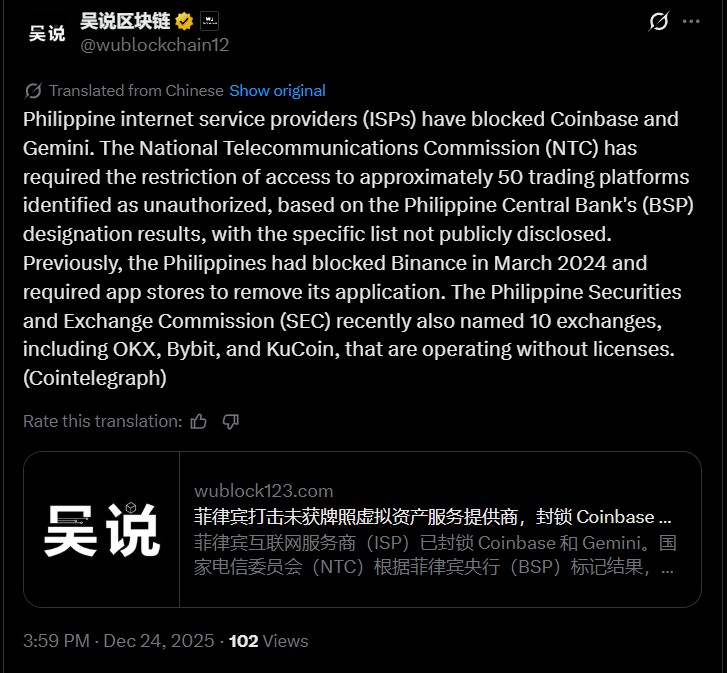
The internet service providers (ISPs) in the Philippines have begun restricting access to international cryptocurrency exchanges Coinbase and Gemini, in response to a regulatory order issued by the National Telecommunications Commission (NTC).
Various users complained that they could not access the platforms, and independent verifications revealed that the services were offline in a number of local ISPs. The action is indicative of a larger governmental initiative to achieve adherence to local crypto laws.
Source: Wu Blockchain X
NTC Targets 50+ unlicensed trading platforms
Local reports state that the NTC ordered the ISPs to block about 50 online trading sites that were reported to be operating without permission. The platforms were registered depending on the designation findings by the Bangko Sentral ng Pilipinas (BSP), the central bank of the country.
Although the BSP has not publicly published the list of platforms impacted, the regulators stressed that the licensing status has become the most important requirement for companies that want to operate in the Philippines.
Coinbase and Gemini Add to the Binance Block List
The shutdown of Coinbase and Gemini is another name on a list of enforcement measures against unlicensed exchanges. Philippine regulators in December 2023 granted Binance a 90-day period to abide by local laws.
Following Binance not non-compliance with the demands, the NTC instructed the ISPs to block the platform in March 2024, and then Apple and Google to take down the Binance platform in their respective app stores. The authorities subsequently made it clear that they were not in a position to formally assist those users who wanted to claim funds that they had invested in the platform that had been banned.
SEC Flags Additional Unlicensed Crypto Exchanges
Philippines Securities and Exchange Commission (SEC) has been carrying on with the monitoring. In the latest announcement, the regulator identified 10 unlicensed exchanges, which include OKX, Bybit, and KuCoin.
This is highlighted by these warnings as the government is paying growing attention to investor protection and regulatory responsibility as more people in the country adopt cryptocurrency.
Controlled Exchanges widen Cryptocurrency
Even after the crackdown, there is an expansion of licensed and compliant companies. In November, regulated exchange PDAX collaborated with payroll company Toku to facilitate stablecoin remuneration of remote employees.
In the meantime, digital bank GoTyme introduced cryptocurrency services in December in a collaboration with US fintech company Alpaca, enabling users to purchase and hold select crypto assets in a regulated banking app.
Conclusion
The strong position of the Philippines regarding regulation makes it evident that the country is sending a message to the world that only licensed platforms will be allowed to operate, and this strategy is geared towards the protection of users, enhancement of market legitimacy, and the creation of a safer digital asset market.
Disclosure: This is financial advice. Do your own research before investing. CoinGabbar has no liability to any financial losses. Cryptocurrencies are extremely unstable, and you can lose all your money.
