Kyrgyzstan’s National Stablecoin KGST Makes Global Debut on Binance Platform

Central Asia just planted its flag on the global crypto map. Kyrgyzstan's sovereign stablecoin, KGST, has officially launched on Binance—turning a regional digital asset into an international player overnight.
Why This Launch Cuts Through the Noise
Forget speculative tokens. KGST represents something far more foundational: a national currency, digitized. It's pegged 1:1 to the Kyrgyz som, backed directly by the National Bank of Kyrgyzstan. This isn't a startup's moonshot; it's a central bank's strategic pivot onto the blockchain.
The move bypasses traditional, sluggish cross-border rails. For Kyrgyz migrant workers sending remittances home—a multi-billion dollar flow for the economy—KGST promises near-instant settlement at a fraction of the cost. It turns a financial burden into a competitive advantage.
The Binance Factor: Liquidity Meets Legitimacy
Listing on the world's largest crypto exchange isn't just about access; it's about validation. Binance's global user base can now trade KGST pairs, injecting immediate liquidity and visibility. For a nation's digital currency, this is the equivalent of a flagship store on Fifth Avenue.
It signals to other central banks, especially in emerging markets, that the infrastructure for national digital currencies is ready—and the major platforms are willing partners. The race for CBDC relevance just found its first sprint lane.
A New Blueprint for Financial Sovereignty?
Kyrgyzstan isn't trying to out-meme Dogecoin. This is a pragmatic use of crypto infrastructure to solve real, local economic challenges—strengthening monetary policy tools and carving out a digital trade corridor. Watch how it handles volatility; its performance could become a case study for a dozen other nations watching from the sidelines.
The launch quietly asks a provocative question: in the age of digital assets, does financial sovereignty come from walling off, or from strategically plugging in? One cynical take? The traditional finance giants who've long profited from moving money slowly between borders are now sweating into their bespoke suits. The game just changed, and the rulebook is being rewritten in code.
How the Kyrgyzstan Stablecoin KGST Could Change Payments
President Sadyr Japarov confirmed on December 24 that KGST, a coin pegged 1:1 to the Kyrgyzstani native currency Som, has been listed on Binance. The project was developed on BNB Chain, allowing fast and low-cost transactions.
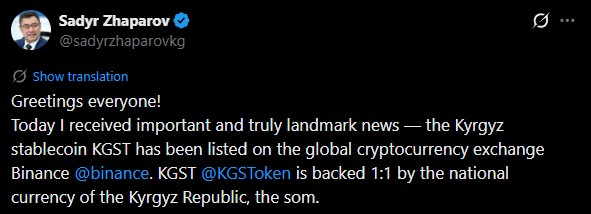
According to Japarov, the Kyrgyzstan stablecoin will help improve cross-border payments and deepen the country’s engagement with the crypto industry. For a nation of roughly seven million people, this marks a major step toward digital finance adoption.
KGST has also made history as the first stablecoin from the Commonwealth of Independent States (CIS) to be listed on a major global exchange.
Binance and CZ Signal More Government Stablecoins Ahead
Following the announcement, Binance founder Changpeng Zhao (CZ), responded by saying that “many more” government-backed stablecoins are expected to be listed on the exchange.

CZ has served as an advisor to Kyrgyzstan since April, offering technical support, consulting, and blockchain expertise. His involvement reflects growing cooperation between governments and major crypto platforms.
KGST and USDKG: Two Stablecoins, Two Goals
Alongside KGST ($0.01142), Kyrgyzstan has also launched USDKG, a US dollar-pegged stablecoin backed by physical gold. USDKG was initially issued on the TRON network with 50 million tokens, with plans to expand to Ethereum.
While KGST supports local currency usage, USDKG offers dollar stability, showing that the nation is exploring multiple digital currency paths at once. Officials have also confirmed plans to pilot a central bank digital currency (CBDC) and establish a national crypto reserve.
The country has over 200 licensed crypto firms, revealed by the Economics and Commerce Minister – Bakyt Sydykov. He also highlighted that the total industry turnover reached 1 trillion soms (over $11.4 billion) in the first 7 months of 2025.
A Wave That isn’t Limited to Any Specifics
Although dollar-based stablecoins like USDT and USDC still dominate the market, more countries are launching their own currency-backed tokens. Japan, Europe, and the UAE have announced similar projects.
The case of Kyrgyzstan stablecoin indicates that governments are adopting blockchain technology in their endeavor to modernize payment systems while maintaining control. But this case also indicates a rise in rivalry between banks, CBDCs, and digital money.
In this regard, with more countries opting for this alternative, one possible answer from the experiment in Kyrgyzstan is a solution to a burning question in the global arena: can stablecoins coexist with or work with a government rather than against one?
