Japanese Yen Weakness Could Drive Crypto Demand in 2026, How?

When traditional finance wobbles, digital assets stand ready.
The Japanese yen's persistent slide isn't just a currency story—it's a potential catalyst for a seismic shift in how a nation protects its wealth. As 2026 approaches, the question isn't *if* capital will seek alternatives, but *where* it will go.
The Flight to Digital Harbors
A weakening yen erodes purchasing power and savings. It forces investors, from institutions to individuals, to look beyond domestic bonds and savings accounts offering near-zero returns. Cryptocurrency, with its borderless nature and non-correlated asset profile, presents a compelling escape hatch. It's a direct bypass of a monetary system that's failing to preserve value.
Beyond Bitcoin: A Broader Portfolio Play
While Bitcoin often leads as 'digital gold,' the demand won't stop there. Savvy investors, already frustrated by traditional finance's low-yield theater, will diversify into major altcoins and DeFi protocols offering staking yields that make bank interest look like a rounding error. This isn't mere speculation; it's capital allocation 2.0.
The Regulatory Green Light
Japan's progressive stance, with the FSA establishing clear crypto frameworks, removes a major barrier to entry. This regulatory clarity, juxtaposed with monetary uncertainty, creates the perfect storm for adoption. It turns crypto from a fringe gamble into a legitimate strategic hedge.
So, how does yen weakness drive crypto demand? It doesn't just nudge—it shoves. It pushes capital out of a leaking ship and into the lifeboats of decentralized finance. When trust in a central bank's management fades, trust in code and cryptographic certainty rises. After all, in finance, sometimes the best trade is an exit from the old game entirely.
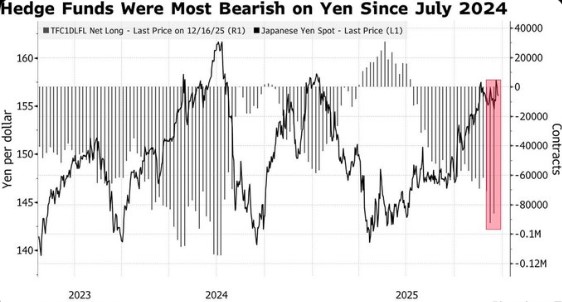
The question is, what is driving this strongly bearish stance, and what will be its impact on everyday investors and cryptocurrencies like Bitcoin and Ethereum?
Understanding Why Hedge Funds Are Shorting the Yen
A short position is an investment strategy where a trader borrows, sells, and then buys back an asset (in this case, a currency) at a lower price after its value has dropped. When many traders do this, the total is called a net short position, showing widespread negative sentiment toward the currency.
The dollar has been gaining strength against the yen in recent months, hence the yen has become less attractive.
The interest rate gap between the U.S. (approximately 3.75-4.00%) and Japan (0.75%) is still very wide, discouraging investors from holding yen-denominated assets. They rather earn more yields in the dollar-based markets.
Despite inflation in Japan being above 2% (around 2.90% as of November 2025), Japan’s real interest rates remain deeply negative because policy rates are low, reducing the currency's appeal.
It somehow reminds the situation of last year, when the USD/JPY rate reached above 160, prompting the Japanese government intervention to defend the domestic money. The current build-up of bearish positions suggest renewed pressure on the currency.
Bank of Japan (BoJ) Policy Adds to Economy Volatility
The Bank of Japan is becoming more hawkish. In Q3 2025, BoJ withdrew ¥61.2 trillion from its balance sheet through QT (Quantitative Tightening), where BoJ aims to reduce its assets in an effort to strengthen its currency and combat inflation.
Core information on Japan’s current policy:
The policy interest rate of the BoJ is 0.75%, which is the highest level seen in 30 years but is still below the neutral level.
Inflation in Japan has broken the 2% threshold for four years.
Some members of the BoJ argue that further increases may be necessary periodically to support the yen.
The Bank of Japan still holds 52% of Japanese Government Bonds (JGBs), indicating that it is one of the major players in the financial markets.
The higher rates and QT make the yen volatile, meaning it fluctuates in value. In the past, the level of volatility within a country’s currencies led to investors looking at other options, including gold, silver, and cryptocurrencies.
How The Currency Weakness Could Boost Crypto Demand?
A currency that is either depreciating or experiencing high volatility can cause investors to switch their interest to alternative places of value, such as:
Gold and silver, traditional hedges against currency weakness
Cryptos such as Bitcoin and Ethereum which are not bound by any geographical region or central bank
Adding to this, the country is moving to cut crypto taxes from the existing 55% to a fixed rate of 20% by 2028. The key features of the new taxation includes:
Profits from crypto trading are taxed separately.
Losses can be carried over for three years, enabling investors to offset their gains with the losses from past years.
Crypto profits are taxed the same way as stocks, making it easier and more predictable.
The proposed tax changes could potentially lead to a surge in cryptocurrency usage in Japan and enhance the operations of prominent exchanges like SBI, GMO, and Coincheck.
Market Takeaways for 2026
A weak yen, increasing interest rates, and favorable tax systems for cryptos are factors that create an attractive environment for cryptos.
Bitcoin, Ethereum, XRP, as well as other risk assets, could witness renewed buying as traders look for an alternative to the falling yen.
Moreover, if the yen’s value steadily remains low, it will be detrimental to the Japanese economy and currency. Even if crypto can be of some use to the country, the Japanese economy may be under pressure as a result of the value of its currency.
