Trump Crosses Federal Line? Fed Chair Powell Accuses DOJ in Explosive Clash

Fed Chair Jerome Powell lobs a grenade at the Department of Justice, alleging political overreach. The accusation centers on former President Trump—did he cross a line with federal authorities?
The Accusation
Powell's statement isn't a whisper in the halls of the Eccles Building—it's a public broadside. The allegation suggests the DOJ may have blurred the lines between legal process and political pressure, a move that could shake institutional trust to its core.
Institutional Fallout
When the head of the central bank openly challenges the nation's top law enforcement agency, it's not policy—it's warfare. The clash exposes deep fissures in Washington's power structure, threatening the perceived independence of both monetary policy and federal prosecution.
Market Tremors
Political instability is the kryptonite of market confidence. Traders hate uncertainty more than they hate losing money—and this public feud between two pillars of the establishment creates nothing but uncertainty. Watch for volatility spikes as the political drama unfolds.
The Bigger Picture
This isn't just about one man or one investigation. It's about the guardrails of American governance. When the referees start fighting on the field, the game itself changes—and not for the better. The real casualty here might be public faith in the system itself.
Remember when 'institutional credibility' was something banks pretended to care about? Now we get to watch two giants of that same establishment tear each other apart in public. The irony is almost as rich as the bankers they regulate.
What is happening?
U.S. Federal Reserve Chair Jerome Powell has publicly accused the Department of Justice (DOJ) of threatening him with criminal prosecution as a way to pressure the Federal Reserve on interest rate decisions.
On January 11, 2026, Powell confirmed that the DOJ served grand jury subpoenas related to his June 2025 testimony before Congress about a $2.5 billion renovation of Federal Reserve buildings.
While the investigation is officially tied to that testimony, Powell says the case has little to do with construction costs and much more to do with political pressure over monetary policy.
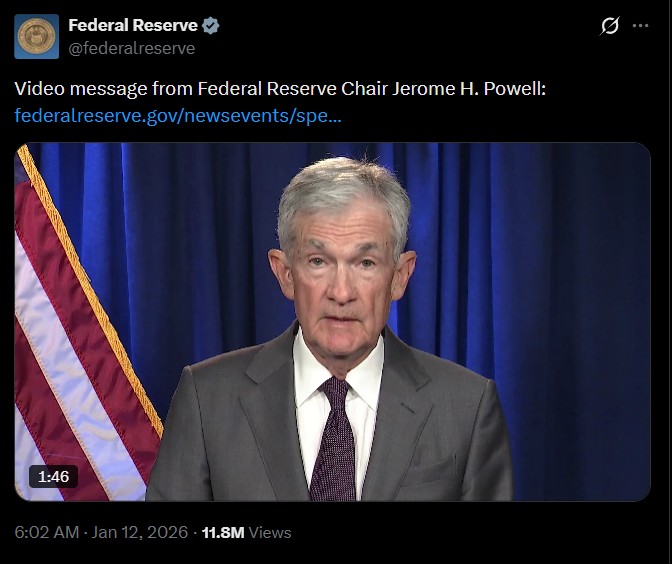 Source: Official X
What Powell is actually accusing the government of?
Powell made an unusually direct statement, saying the criminal threat is a “pretext” and that the real motive is retaliation for the Fed’s refusal to follow President Trump’s demands to cut interest rates.
According to Powell, the administration is using the legal system as a tool of intimidation to influence how the central bank sets rates.
This marks the first time a sitting Fed Chair has openly accused the executive branch of weaponizing criminal prosecution to control monetary policy.
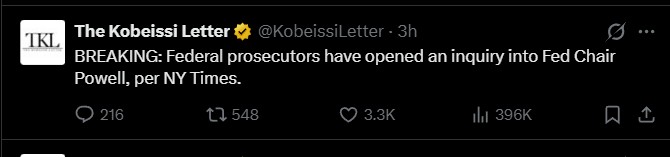 Source: X
Why do interest rates matter here?
Interest rates affect everything from inflation and jobs to government borrowing costs. President TRUMP has repeatedly pushed the Fed to cut rates sharply, arguing that lower rates would boost growth and reduce the cost of servicing federal debt.
However, on December 18, 2025, the Federal Open Market Committee (FOMC) decided to hold rates steady, citing economic data and inflation risks. Just 21 days later, the DOJ subpoenas were issued—fueling concerns that the investigation is linked to that decision.
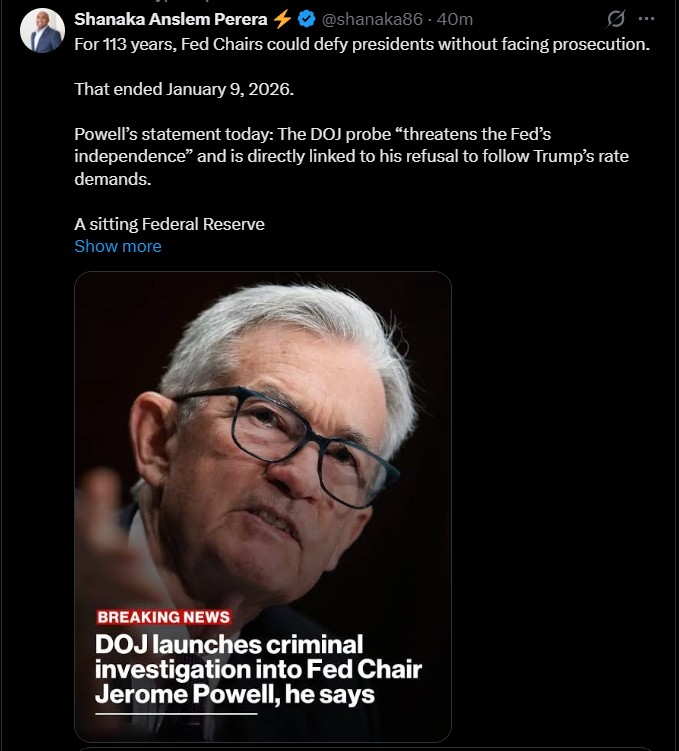 Source: X
Why is this a big deal?
The Federal Reserve was designed to operate independently of political power since its creation in 1913. Central bank independence is considered essential for stable economic policy, preventing short-term political goals from driving interest rate decisions.
If a president can pressure the Fed through legal threats, experts warn it could permanently weaken this independence—not through legislation, but through fear.
What did Powell say clearly?
Jerome stated plainly that the threat of criminal charges is a consequence of the federal setting of rates based on evidence and economic conditions, rather than presidential preferences.
He emphasized that this situation is about whether monetary policy will be guided by facts—or by political intimidation. He also said he intends to continue doing the job the Senate confirmed him to do, “with integrity.”
If Powell gives in, Fed interest rates could be cut to match White House demands, setting a dangerous precedent for future chairs.
If he resists, he could face prosecution or removal, with a more compliant replacement installed. Either outcome risks undermining the Fed’s independence.
Market and political reaction
Markets reacted quickly. Stock futures fell, the dollar weakened slightly, and volatility increased. Politically, concern crossed party lines. Republican Senator Thom Tillis questioned the DOJ’s credibility, while others warned of executive overreach.
Why do people say “most won’t realize it yet”?
Because the issue is being framed as a building renovation investigation, many may miss its deeper meaning. But analysts warn this could represent the most significant shift in U.S. monetary governance in over a century—one whose consequences may only become clear months from now.
Conclusion
Jerome's statement signals a serious threat to Federal Reserve independence, raising concerns that political pressure and legal intimidation could reshape how U.S. monetary policy is decided.
Disclaimer: This is not financial advice. Please DYOR before investing. CoinGabbar is not responsible for any financial losses. Crypto assets are highly volatile, and you can lose your entire investment.
