Vitalik Buterin: Ethereum’s Future Depends on Superior Decentralized Stablecoins — The Critical Reason

Ethereum's co-founder just dropped a bombshell: the network's long-term survival isn't about faster transactions or lower fees—it's about building a stablecoin that doesn't rely on Wall Street's promises.
The Centralized Achilles' Heel
Most 'stable' assets today are backed by traditional finance—bank accounts, treasury bills, corporate debt. That's not decentralization; it's just outsourcing trust. A single regulator's pen stroke or a bank failure could unravel the entire facade, tethering crypto's fate to the very system it aimed to disrupt.
Why Decentralized Collateral is Non-Negotiable
True independence means the stability mechanism lives on-chain. Think ETH-backed, crypto-native, algorithmically balanced—immune to real-world seizures and political whims. Without it, every decentralized application built on Ethereum has a centralized point of failure lurking in its foundation. It's like building a fortress on rented land.
The Liquidity Lifeline
Decentralized finance needs a native bloodline. For lending, borrowing, and trading to function at scale without intermediaries, the primary medium of exchange must be sovereign. A robust, decentralized stablecoin isn't just another asset; it's the public utility that keeps the entire economic engine running—especially when traditional markets freeze up, which they inevitably do.
Until this puzzle is solved, Ethereum's grand vision of a global, permissionless computer remains partially mortgaged to the old guard. The race isn't for the slickest app; it's for the most resilient dollar. After all, what's the point of beating Wall Street at its own game if you still need its permission to play?
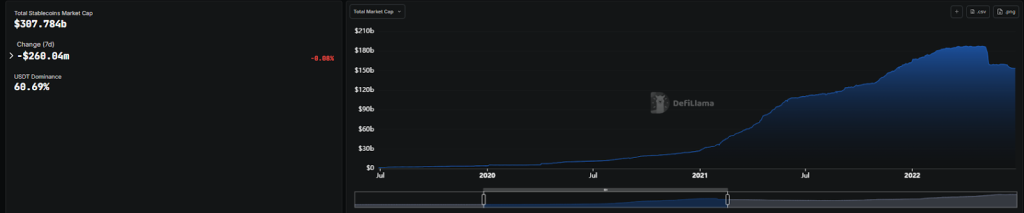 Source: DefiLlama
Decentralized stablecoins remain far smaller by comparison with Ethena’s USDe and Sky Dollar, each hovering around $6.3 billion in market value, while Dai, once Ethereum’s flagship decentralized stablecoin, has declined to roughly $4.5 billion in circulation after years of contraction.
Buterin Highlights Hidden Risks Behind Dollar-Pegged Stablecoins
Buterin’s comments came in response to Gabriel Shapiro of Delphi Labs, who described ethereum as an increasingly “contrarian bet” against venture-backed trends.
it's increasingly obvious that Ethereum is a contrarian bet against most of what crypto VCs are betting on
they're betting on:
*gambling
*CeDeFi
*custodial stablecoins
*'neo-banks'
Ethereum is tripling down on disrupting power to enable sovereign individuals
While acknowledging the short-term usefulness of dollar-pegged assets, Buterin argued that deeper reliance on the U.S. dollar exposes Ethereum-based finance to monetary policy decisions and geopolitical risks beyond its control.
Over a longer horizon, he has questioned what happens if the dollar experiences sustained inflation or loses credibility, noting that Ethereum’s vision of nation-state resilience implies independence even from dominant fiat price references.
We need better decentralized stablecoins. IMO three problems:
1. Ideally figure out an index to track that's better than USD price
2. Oracle design that's decentralized and is not capturable with a large pool of money
3. Solve the problem that staking yield is competition…
Beyond the peg itself, Buterin identified two deeper technical challenges that have repeatedly undermined decentralized stablecoins.
The first is oracle design, which stablecoins rely on price feeds to manage collateral and liquidations, but if those feeds can be manipulated by well-funded actors, protocols must resort to expensive economic defenses.
Buterin noted that those costs are often passed on to users through higher fees, inflation, or aggressive value extraction, weakening usability and trust.
Another issue is Ethereum’s staking economy, with rising staking yields competing directly with stablecoin designs that require ETH as collateral, making it less appealing to lock assets unless protocols can offset or integrate those returns.
Lessons From Terra Still Shape Stablecoin Design
Buterin outlined possible paths forward, ranging from sharply reducing staking yields to creating new staking categories with lower slashing risk to redesigning collateral systems so staking and stablecoin use are compatible.
He also emphasized that stablecoins cannot rely on fixed collateral ratios and must be able to rebalance during sharp market moves, even if that means temporarily sacrificing yield.
The debate is not theoretical, as past attempts at decentralized stablecoins have ended badly.
Terra’s UST collapse in 2022 wiped out tens of billions of dollars, and Terraform Labs founder Do Kwon was sentenced last month to 15 years in prison, reinforcing skepticism around high-yield, algorithmic designs.
 US District Judge Paul A. Engelmayer handed down a 15-year prison sentence to Terraform Labs co-founder Do Kwon for Terra's $40 billion crash.#DoKwon #TerraUSD #CryptoFraudhttps://t.co/7N3WlnQrTB
Since then, progress has been cautious, with MakerDAO’s DAI remaining widely used, but its growth has slowed, and newer designs have yet to reach a comparable scale.
Reflexer’s RAI, an ETH-backed stablecoin not pegged to fiat, was once praised by Buterin as an ideal model, yet its limited adoption and trade-offs around staking yield highlighted how difficult these designs are to sustain.
The comments sparked wide discussion within the Ethereum community, with some developers and users arguing that non-USD stablecoins are conceptually appealing but lack real demand, pointing out that most users still default to dollar-pegged assets for payments and savings.
Others pushed back, saying the difficulty of the problem does not make it unsolvable and that a truly decentralized, free-floating stablecoin with resilient oracles is consistent with Ethereum’s long-term mission, even if mass adoption remains years away.
