South Korea’s Crypto Ban Lifts After Nine Years: The 2026 Market Revolution Begins

Regulatory walls crumble. After nearly a decade of prohibition, South Korea flings open its digital doors to cryptocurrency markets. The shift isn't just procedural—it's a tectonic realignment for global finance.
The Nine-Year Thaw
Forget gradual easing. This is a policy U-turn executed at institutional scale. The Financial Services Commission scraps legacy frameworks, replacing blanket bans with a structured regulatory sandbox. Legacy finance braces for impact as capital eyes new, decentralized horizons.
Market Mechanics Rewired
Liquidity patterns shift overnight. Domestic exchanges report order-book depth multiplying as institutional players establish first positions. The won's presence in crypto trading pairs surges—a direct challenge to the dollar's long-held dominance. Volatility isn't just expected; it's engineered into opening strategies.
The Global Ripple Effect
Neighboring jurisdictions recalibrate. Japan's FSA fast-tracks its own digital asset reviews, while Singapore doubles down on its pro-innovation stance. The message is clear: Asia's financial map is being redrawn, with crypto at its center. Traditional hubs can adapt or become relics.
Investor Sentiment vs. Regulatory Reality
Retail frenzy meets institutional caution. While social channels buzz with moon-shot predictions, corporate treasuries move with measured, algorithmic precision. The real action isn't in speculative altcoins—it's in the infrastructure bets: custody solutions, compliance tech, and cross-border settlement layers.
Looking Beyond the Hype Cycle
This isn't 2017's wild west. The post-ban landscape is built on compliance-by-design, with real-time auditing and investor protections hardwired into licensed platforms. The game has changed: it's no longer about evading regulators, but about building systems robust enough to win their approval.
The new era demands a cold-eyed view. Success won't belong to the greatest hype-men, but to the architects who bridge decentralized potential with institutional-grade stability—proving, once again, that in finance, the most profitable revolutions are often the most boringly well-regulated.
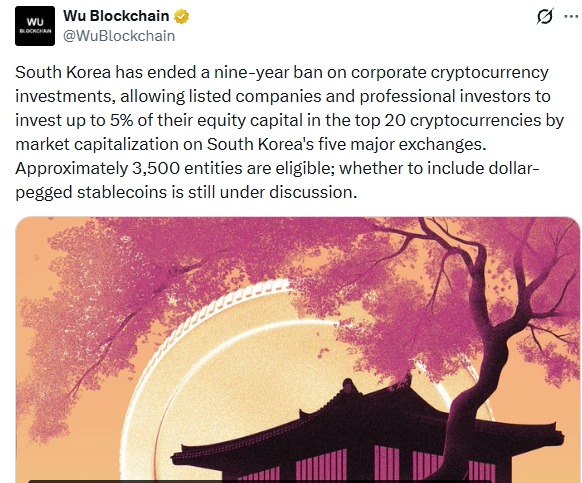
The new guidelines are a cornerstone of the government’s broader "2026 Economic Growth Strategy." By opening the doors to roughly 3,500 eligible entities, including publicly listed firms and professional investment houses, South Korea is signaling that it is finally ready to treat Bitcoin and ethereum as legitimate parts of a corporate balance sheet. For nearly a decade, retail investors made up almost 100% of the local market; that era of imbalance is officially coming to a close.
How Ending the South Korea Crypto Ban Changes Everything
The FSC isn’t exactly throwing the doors wide open; instead, they are carefully engineering a controlled entry point. Under this new framework, South Korean corporations are permitted to dip their toes in the water by allocating up to 5% of their equity capital to digital assets each year. To mitigate systemic risk, the government is restricting these investments to the top 20 cryptocurrencies by market capitalization, think established giants like Bitcoin, Ethereum, and Solana. Furthermore, all trades must be funneled through the nation’s "Big Five" regulated exchanges: Upbit, Bithumb, Coinone, Korbit, and GOPAX.
This MOVE is designed to stop the massive "capital flight" that saw over 76 trillion won ($52 billion) leave Korea as investors looked for opportunities overseas. By allowing local firms to invest at home, the government hopes to stabilize the won and foster a domestic ecosystem for a won-denominated stablecoin.
The "Safety First" Approach
Regulators are still moving with caution. Exchanges will be required to use staggered execution for large corporate orders. This means a giant company can't just "dump" or "pump" the market in one go; their orders will be broken into smaller pieces to keep the price from swinging wildly. While this might frustrate high-speed traders, it is a necessary step to prevent the speculative chaos that led to the original 2017 ban.
Industry Pushback: Is 5% Enough?
While most people are celebrating, some industry leaders think the government is being a bit too "cautious." Critics point out that in the U.S., Japan, and the EU, there are no hard caps like the 5% equity limit. They argue that these restrictions might prevent the rise of "Digital Asset Treasury" companies, firms like Japan’s Metaplanet that have seen their stock prices soar by holding massive amounts of Bitcoin. One local official warned that being too conservative could leave Korea in the dust as the global crypto race accelerates.
Conclusion
Wrapping things up, South Korea is no longer running away from the future of finance. By ending the South Korea crypto ban, the FSC is trying to find a middle ground between total freedom and total control. The final guidelines are expected to drop in the coming weeks, with corporate trading desks likely to go live by the end of 2026. After nearly a decade of exile, South Korean institutions are finally coming home to a market that is more mature, better regulated, and ready for big business.
