LiquidChain Shatters Barriers: New Layer-3 Network Unifies Bitcoin, Ethereum, and Solana

Forget the bridge wars. A new player just rewired the entire multi-chain battlefield.
LiquidChain has launched a radical new product designed to do what no single protocol has managed: create a seamless, unified layer-3 network that directly connects the titans of crypto—Bitcoin, Ethereum, and Solana. This isn't another fragile bridge; it's an interoperability engine built for the age of mega-chains.
The End of Fragmented Liquidity
The vision is starkly simple. Instead of forcing assets through a gauntlet of separate, often insecure bridges, LiquidChain's layer-3 solution acts as a universal transit hub. It cuts out the middlemen and bypasses the compounding risks that have plagued cross-chain movement. Developers can now build applications that natively tap into the unique strengths of all three ecosystems simultaneously—Bitcoin's unparalleled security, Ethereum's vast DeFi landscape, and Solana's blistering speed.
A New Architecture for a Multi-Chain World
This launch signals a fundamental shift. The narrative is moving from isolated chains competing for dominance to interconnected networks amplifying each other's value. LiquidChain's architecture proposes a future where capital and data flow as freely between Bitcoin, Ethereum, and Solana as they do within their own respective walls. It turns three walled gardens into one sprawling, hyper-connected metropolis.
Of course, the finance cynics will note this is another ambitious bet on a problem that has burned billions in the past—proving once again that in crypto, the most lucrative opportunities often lie in selling the shovels to fix the last gold rush's catastrophic failures. But if it works? It doesn't just connect chains. It redefines the game.
What LiquidChain Is Trying to Solve
The Layer-3 model LiquidChain is using builds on problems that are already familiar.
Bitcoin remains the most secure network in crypto, but it is not designed for complex applications. ethereum allows smart contracts, but congestion and fees are still an issue during busy periods. Solana is fast and cheap, yet largely isolated from Bitcoin-native liquidity.
LiquidChain does not try to compete with any of them. Instead, it treats these chains as settlement layers. Execution, automation, and coordination happen on LiquidChain, while final settlement remains on the underlying networks.
For developers, this removes the need to deploy and maintain separate versions of the same application on multiple chains. For users, it reduces the friction of bridging assets and managing several wallets. Most of that complexity is handled in the background.
Where $LIQUID Fits In
is not presented as a passive asset. It has an active role inside the network.
It is used for transaction fees, staking, and governance. Validators and infrastructure providers stake $LIQUID to help secure the system. Users interact with the token when accessing Layer-3 services or participating in network decisions.
The design is modular. New blockchains can be added over time without breaking existing applications. That flexibility matters in a market where dominant platforms can change quickly.
The goal is for users to focus on the application they are using, not the chain underneath it.
Token Supply and Allocation
The total supply of $LIQUID is capped at 11,800,000,100 tokens.
35% is allocated to development, covering ongoing work on the Layer-3 network and its infrastructure. LiquidLabs controls 32.5%, which is used for marketing and ecosystem growth. AquaVault holds 15% for partnerships and expansion efforts.
Rewards account for 10%, mainly tied to staking and community incentives. The remaining 7.5% is reserved for growth initiatives and exchange listings.

Most of the supply is directed toward building and supporting the network rather than short-term promotion.
Activity and Staking
The presale has become the main point of entry for early participants. Many are positioning themselves ahead of future network launches and integrations.
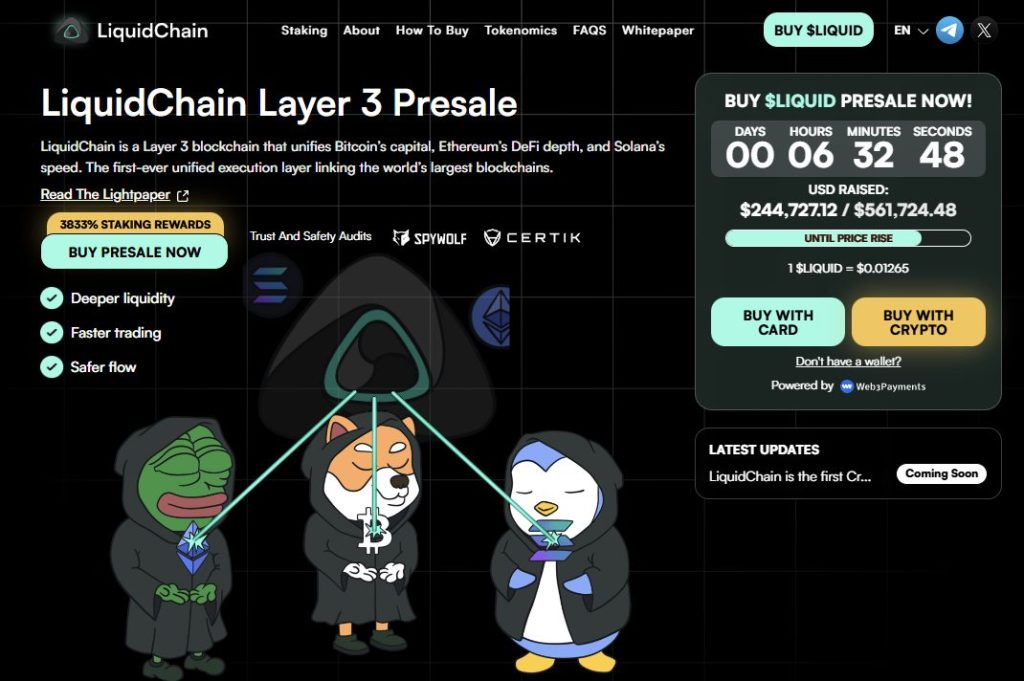
Staking is already active. More than 15,000,000 $LIQUID tokens have been staked so far, based on figures shown on the platform. That level of participation suggests some buyers are committing tokens instead of keeping them liquid.
Staking supports network security and validator operations. Current APYs are high, which is typical for early-stage networks. These rates are expected to change as adoption increases and more tokens enter circulation.
The presale price currently sits at $0.01265. It increases gradually every few days as new stages are reached. The structure rewards earlier participation without relying on aggressive messaging or fixed price targets.
How to Get $LIQUID?
is on infrastructure, coordination, and long-term usability across major blockchains.
By targeting interoperability between Bitcoin, Ethereum, and solana at the execution level, it addresses a problem that has slowed application development for years. Whether that approach succeeds will depend on execution, adoption, and continued development.
For those looking into the presale, participation involves connecting a supported wallet, selecting an amount of $LIQUID, and confirming the transaction. Card-based options are also available through compatible wallets.
As with any early-stage project, precaution matters. Still, LiquidChain’s early numbers, active staking, and infrastructure-first positioning make it a project that is likely to stay on the radar as the Layer-3 space develops.
Discover the future of cross-chain innovation with LiquidChain:
Presale: https://liquidchain.com/
Social: https://x.com/getliquidchain
