ZachXBT Exposes “Canadian” Scammer Who Stole $2M Via Fake Coinbase Support

Crypto investigator ZachXBT just ripped the mask off a major scam operation—and the face underneath claims to be Canadian.
The $2M Fake Support Scheme
Forget sophisticated hacks. This grift relied on old-school social engineering, just dressed in crypto's latest threads. The scammer posed as official Coinbase support, tricking users into handing over access to their accounts. Two million dollars vanished—poof—into the digital ether.
Why This One Stings
It's a brutal reminder: the biggest vulnerability in crypto isn't a smart contract bug; it's the person holding the keys. Scammers don't need to break the encryption when they can just ask for the password. The 'Canadian' angle adds a layer of audacious branding, exploiting perceived trustworthiness until the wallet's drained.
The industry's dirty little secret? For every billion-dollar protocol pumping its treasury, there's a guy in a basement running a fake help desk. The tech evolves, but the con stays timeless. Stay skeptical out there.
ZachXBT Tracks Coinbase Scammer Through Screenshots and Wallet Data
According to the investigator, the suspect relied on classic social engineering tactics rather than technical exploits, manipulating victims into believing their accounts were under threat and needed immediate intervention.
ZachXBT said he was able to trace the activity by cross-referencing screenshots shared in Telegram group chats, social media posts, and on-chain transaction data.
In an instance, dated Dec. 30, 2024, the alleged scammer posted a screenshot boasting of a 21,000 XRP theft, worth about $44,000 at the time, taken from a Coinbase user.
Further analysis linked that XRP address to additional Coinbase-related thefts totaling roughly $500,000.
The investigator said the suspect routinely converted stolen XRP into Bitcoin using instant exchange services, a move intended to obscure transaction trails.
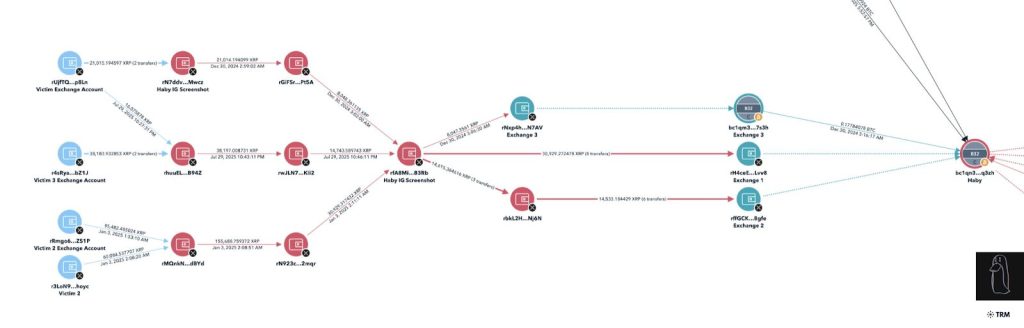
By analyzing transaction timing and wallet balances, ZachXBT said he identified a bitcoin address that later displayed a balance of about $237,000 in February 2025, matching screenshots the suspect had shared while showing off his funds in private chats.
Tracing backward from that address revealed three more Coinbase impersonation thefts worth more than $560,000.
ZachXBT also shared a leaked screen recording that allegedly shows the suspect on a call with a victim, impersonating Coinbase support.
In the video, the caller is heard guiding the target through what appeared to be fake security steps while inadvertently revealing an email address and Telegram account tied to the operation.
7/ In this leaked video here’s Haby as a caller social engineering a target.
In the screen recording he leaks the email habyclown@gmail[.]com and his Telegram account with a number. pic.twitter.com/rd0FOZWoxr
The suspect reportedly bought expensive Telegram usernames and deleted older accounts in an attempt to evade detection, though repeated online bragging made attribution easier.
Crypto Users Face Rising Losses as Social Engineering Attacks Spread
The case surfaced as authorities in India recently arrested a former Coinbase customer support agent in Hyderabad over a separate data breach affecting nearly 70,000 users.
 A former @Coinbase support agent was arrested in India over a data breach affecting nearly 70,000 users.#Coinbase #Indiahttps://t.co/ebWl6bUXq8
Coinbase CEO Brian Armstrong said the breach stemmed from a bribery scheme targeting offshore support staff and resulted in about $307 million in remediation and reimbursement costs.
Coinbase refused to pay a $20 million ransom linked to the incident and instead launched a bounty program to aid investigations.
Social engineering scams like the one described by ZachXBT typically begin with unsolicited calls, texts, or emails that appear to come from a legitimate company.
Scammers often create urgency by claiming there has been suspicious activity or an imminent account compromise, then pressure victims into revealing login credentials or two-factor authentication codes or transferring funds to wallets controlled by the attacker.
The exposure of the alleged Canadian scammer follows other recent enforcement actions. In the United States, prosecutors charged a 23-year-old Brooklyn resident with stealing about $16 million from roughly 100 Coinbase users through a similar impersonation scheme.
That investigation also relied on blockchain analysis and resulted in the seizure of cash and digital assets, with recovery efforts ongoing.

Industry data show crypto theft remains widespread, with more than $3.4 billion stolen across the sector between January and early December 2025.
Security experts continue to urge users to avoid responding to unsolicited messages, never share passwords or recovery phrases, and only contact support through official websites or apps.
