Masked Gunmen Steal Crypto USB in France as Tax Official Caught Selling Data to Gangs

France's crypto scene just got a dose of real-world drama. Forget hacks and smart contract exploits—this heist had balaclavas and a corrupt official on the payroll.
The Inside Job
It starts with a tax official. Instead of auditing returns, they're allegedly selling sensitive data to organized crime groups. Names, addresses, portfolio details—all for sale. It's the kind of insider access that makes phishing look amateur hour.
The Heist
Armed with that intel, masked gunmen pull off a targeted raid. Their prize? A physical USB drive loaded with cryptocurrency. No fancy digital sleuthing required, just old-fashioned intimidation and a very specific shopping list. It highlights a brutal truth: your cold storage isn't cold if someone knows where you keep it.
Security's Weakest Link
The story cuts to the core of crypto security. We fortify our wallets with 2FA and hardware keys, but often overlook the human element. A bribed official, a coerced family member, a simple slip in conversation—these are the cracks the system rarely patches. It's a stark reminder that decentralization doesn't make you bulletproof.
Regulatory Whack-a-Mole
Authorities are scrambling. The incident puts regulators in a bind—they're busy drafting DeFi frameworks while criminals are literally beating down doors. Expect louder calls for surveillance and KYC, even as the community screams about privacy. Another classic case of regulation chasing crime, always three steps behind the tech. Just ask your traditional bank—they've been losing this game for decades.
This isn't a flaw in the code; it's a feature of human nature. The tech promises sovereignty, but the old-world rules of greed and violence still apply. Maybe the real security audit needed isn't for the blockchain, but for the people we trust to guard it. After all, in the race between armor and ammunition, the insider always gets the first shot.
Tax Official Caught Selling Targeting Data to Criminal Gangs
The attack comes amid revelations that criminals access government databases to identify crypto holders.
We're now learning of a French tax agent who used privileged access to find and target cryptocurrency owners on behalf of an unknown third party.https://t.co/izh8QRxdJZ
— Jameson Lopp (@lopp) January 8, 2026According to Le Parisien, tax official Ghalia C. was imprisoned on June 30, 2025, in Bobigny after using tax software to provide addresses to organized crime.
Prosecutors say she searched for files on crypto investors, billionaire Vincent Bolloré, and prison officials before selling the information.
“She refused to give her phone passcode and the name of the person who hired her; that’s criminal behavior,” the public prosecutor stated. “This woman abused her position in a completely abnormal manner to serve a hardened criminal.“
Investigators discovered Ghalia accessed “” tax software to locate targets for violent robberies.
Her searches specifically included crypto investors. One prison officer was attacked on September 26, 2024, when three armed men burst into his Montreuil home after she provided his address.
Police found large cash deposits and Western Union transfers in her accounts. She received approximately 800 euros per operation, according to confessions from arrested henchmen.
Her lawyer, however, argued, “the justice system is making a lot of assumptions,” but prosecutors charged her in a similar Nancy case involving attacks on prison guards’ homes.
Physical Attacks Reach Record Levels
Physical violence against crypto holders has escalated dramatically, with Lopp’s database documenting 269 total attacks since tracking began.
The year 2025 has recorded 65 incidents, averaging more than one per week.
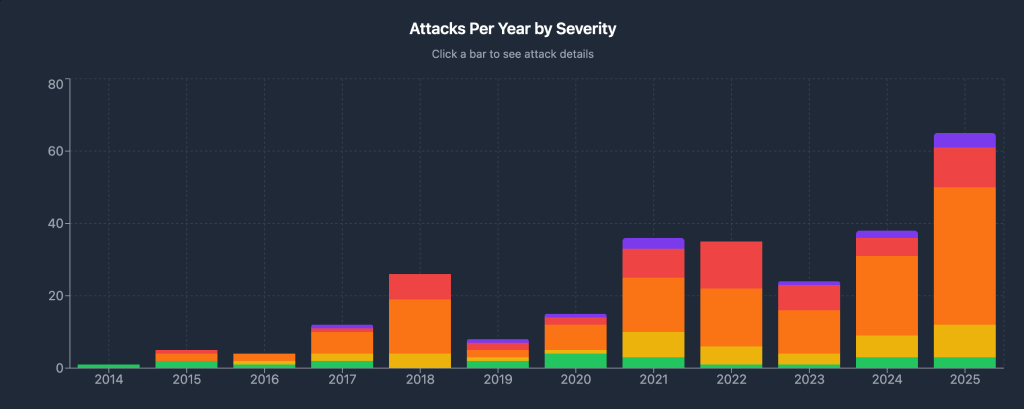
Criminals successfully steal assets in 2/3 of documented attacks, and 60% of perpetrators are eventually captured.
France has emerged as a particular hotspot, with Parisian authorities believing one organized crime ring perpetrates multiple recent kidnappings.
Western Europe accounts for 27% of global attacks, followed by North America at 24% and Asia-Pacific at 20%.

Market Correlation and Evolving Risk Assessment
Investor Haseeb Qureshi’s analysis revealed critical insights about attack patterns.
His regression found a correlation of 0.67 between crypto market capitalization and attack frequency.
“Simple regression yields an R² of 0.45, meaning 45% of the variance in violence is explained simply by price,” Qureshi noted.
Are rates of physical violence against crypto users increasing?
Jameson @lopp has been quietly maintaining a database of "wrench attacks"—violent attacks against crypto users to steal their crypto. It's the closest thing we have to a ground truth of whether holding crypto has… pic.twitter.com/VMmI4ZeC3B
Normalization analysis provided a nuanced perspective. When adjusting for population growth, Qureshi found that “crypto was actually more dangerous in 2015 and in 2018, back when crypto was very small.”
During that time, Coinbase’s monthly active users increased 60x from 2 million to 120 million, meaning violence has not grown proportionally.
“There has indeed been a recent uptick in violent events per user,” Qureshi acknowledged. “But it’s a moderate increase, roughly in line with 2021 rates of violence, and significantly lower than pre-2019.“
Rising Violence Severity and Criminal Sophistication
Attacks have grown substantially more violent. Haseeb’s severity classification shows 51% now classified as “,” involving armed robbery, kidnapping, or home invasion.
Another 21% qualify as “,” including torture and severed body parts, while fatal outcomes account for 5%.
Criminals have adopted sophisticated tactics, with home invasions representing 25% of attacks.
Perpetrators often pose as delivery workers to gain entry, while kidnappings involve surveillance. OTC trades have become particularly dangerous, with attackers luring victims to hotel rooms.
“Dubai is actually from a number of different perspectives very risky,” Lopp noted, though adding that Dubai maintains a 100% success rate in catching criminals before they escape.
The UAE’s nine recorded attacks all resulted in arrests, in contrast to jurisdictions where criminals frequently evade capture.
Security Recommendations
“,” Lopp advised bluntly. “”
His recommendations include avoiding face-to-face trades, maintaining situational awareness, refusing food or drinks from untrusted sources, and implementing distributed multi-signature setups that make rapid fund movement difficult.
Qureshi provided even more practical guidance. He advised to “stay in a SAFE city, ideally in a building with 24/7 security. Don’t wear crypto swag in public or signal that you have crypto on you.“
He recommended using services like DeleteMe to remove personal data from brokers, establishing PO boxes for commercial mail, and maintaining separate hot wallets with meaningful amounts that could be surrendered without compromising entire holdings.
The Manosque case remains under investigation, with financial losses yet to be assessed. Authorities continue pursuing leads on the three suspects who remain at large.
