Shiba Inu Price Prediction 2026: On-Chain Data Reveals Major Supply Contraction

Shiba Inu's on-chain metrics are flashing a signal traders haven't seen in months—a genuine supply squeeze. Forget the memes for a second; the data tells a story of coins moving off exchanges and into cold storage, a classic prelude to reduced selling pressure.
The Great Hold Tightens
Network activity shows large holders, the so-called 'whales,' aren't budging. Their wallets are locked, and smaller investors are following suit, pulling tokens out of liquid trading pools. This isn't hype-driven accumulation; it's a calculated shift in asset distribution that historically tightens available supply.
Liquidity Dries Up
The direct result? Exchange reserves are thinning. Fewer tokens sitting on order books mean even modest buy-side demand can trigger disproportionate price moves. It's basic economics—when the floating supply contracts, the price mechanism gets hypersensitive.
A Cynical Wind at Its Back
Let's be real—in a market where traditional finance pundits still call crypto a 'passing fad,' these on-chain moves are a silent rebellion. While Wall Street debates ETFs, the blockchain ledger shows capital voting with its feet, or rather, with its private keys. The 'dumb money' narrative gets harder to sell when the data screams strategic holding.
Prediction: Volatility with an Upward Bias
The setup is clear. This supply contraction doesn't guarantee a moonshot, but it builds a structural floor. Any positive catalyst—a major listing, a protocol upgrade, or even broader market momentum—now hits a market with fewer immediate sellers. Expect sharp, explosive moves when the dam breaks. The 2026 outlook hinges on this simple truth: scarcity, even manufactured, precedes value.
 #Shib #ShibArmy #memecoin pic.twitter.com/Se9ZjrZoOP
— Top Altcoins (@TopAltcoins_net) January 1, 2026
The renewed focus comes as SHIB begins the year consolidating after an extended period of weakness. Analysts note that price stability near established support levels often draws interest from long-term holders, particularly when accompanied by measurable changes in token distribution and network activity.
Exchange Supply Declines as Burns Accelerate
Recent on-chain data shows a sharp increase in SHIB token burns, reducing circulating supply. Daily burns surged by more than 10,000% at one point, removing approximately 173 million tokens from circulation. Over the same 24-hour period, more than 200 billion SHIB were withdrawn from centralized exchanges, lowering exchange-held supply to around 81 trillion tokens, or roughly 14% of the circulating total.
Lower exchange balances are commonly interpreted as a reduction in near-term sell pressure, as fewer tokens are readily available for spot trading. Analysts often compare this metric with similar trends observed in large-cap assets such as Bitcoin and Ethereum, where declining exchange supply has historically coincided with accumulation phases rather than immediate price moves.
Holder Growth Points to Long-Term Accumulation
Despite uneven market conditions throughout 2025, Shiba Inu’s holder base continued to expand. On-chain records show that more than 70,000 new addresses joined the network over the past year, bringing the total number of holders to approximately 1.54 million. At the same time, long-term holders reduced exchange balances by an estimated 60 trillion SHIB, reinforcing the view that accumulation has taken place away from trading venues.
Such behavior is often associated with investors shifting assets into self-custody, reflecting a longer investment horizon. While holder growth alone does not determine price direction, it provides context for understanding broader sentiment within the SHIB ecosystem.
Technical Signals Remain Unconfirmed
From a technical perspective, market watchers are monitoring the relationship between short- and long-term moving averages. The 50-day exponential moving average remains below the 200-day EMA, though the gap has narrowed following weeks of consolidation. A crossover between these averages, commonly referred to as a golden cross, is widely tracked as a trend signal, but analysts caution that it typically forms after prolonged base-building rather than rapid price appreciation.
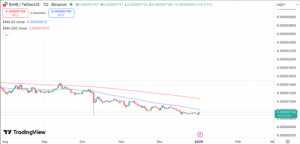
Image Courtasy: Trading View
Other chart patterns, including narrowing price ranges and early reversal formations, suggest stabilization rather than a confirmed trend shift. Momentum indicators on higher timeframes have begun to improve, though they remain sensitive to broader market conditions.
Broader Implications for the SHIB Ecosystem
Taken together, declining exchange supply, rising burn activity, and steady holder growth point to structural adjustments within the shiba inu network. These developments may influence how traders and long-term investors assess risk and positioning, particularly as the memecoin sector searches for direction.
While technical confirmation has yet to emerge, the current setup highlights how on-chain metrics can provide insight into market behavior beyond short-term price movements. As with other cryptocurrencies, SHIB’s trajectory will likely remain tied to overall crypto market sentiment and liquidity conditions rather than isolated indicators alone.
Maxi Doge ($MAXI) Brings Meme Coins’ Energy to the Trading Community

As Shiba Inu continues to trade as one of the most established meme assets in the market, investor attention is gradually shifting toward newer, higher-beta alternatives with stronger upside narratives. Maxi Doge ($MAXI) is emerging as one such contender, blending meme culture with a leverage-focused trading ethos aimed squarely at retail momentum traders.
This narrative is already reflected in presale participation. At the time of writing, Maxi Doge has raised , placing the project close to its next funding milestone. The combination of community-driven engagement, competitive trading events, and a marketing strategy backed by presale-funded capital deployment positions $MAXI as a speculative rotation play for traders seeking exposure beyond established meme coins like SHIB.
Buy Maxi DOGE HereThe post shiba inu price Prediction: On-Chain Data Signals Supply Contraction appeared first on icobench.com.
