How Turkmenistan’s Crypto Mining & Exchange Laws Are Reshaping Its Economic Future

Turkmenistan's government just placed a massive bet on digital assets—and the entire economy is feeling the shockwaves.
While most nations tiptoe around crypto regulation, Turkmenistan slammed its fist on the table. New laws now govern everything from industrial-scale mining operations to licensed digital asset exchanges. The goal? Control the flow, capture the value, and turn crypto into a state-managed resource.
The Mining Play: Powering the Digital Gold Rush
Forget clandestine basement rigs. The law greenlights large-scale, licensed mining farms, positioning the country to leverage its vast natural gas reserves. Cheap energy gets converted into computational power, which gets converted into Bitcoin and other Proof-of-Work assets. It's a modern-day alchemy, turning fossil fuels into digital gold on the state's balance sheet.
The Exchange Gambit: Building Fortresses, Not Free Markets
Don't expect a wild west of peer-to-peer trading. Licensed exchanges operate under strict capital controls and reporting mandates. Every transaction gets tracked. Every withdrawal gets scrutinized. The state isn't fostering a free market; it's building a fortified canal to channel crypto wealth directly into official coffers.
The Economic Ripple Effect
This isn't just a tech policy—it's a full-spectrum economic strategy. By formalizing crypto, Turkmenistan aims to attract foreign investment in mining infrastructure, create a new class of tech jobs, and open a hard-currency revenue stream that bypasses traditional sanctions and banking choke points. It's a daring attempt to future-proof a resource-dependent economy.
Of course, the old-guard finance bureaucrats are probably sweating over their spreadsheets—after all, it's harder to hide budget shortfalls when the treasury's backed by a volatile, decentralized asset that laughs at central bank pronouncements.
The gamble is clear: embrace the chaos of crypto to create order, or get left behind in the digital dust. Turkmenistan just rolled the dice.
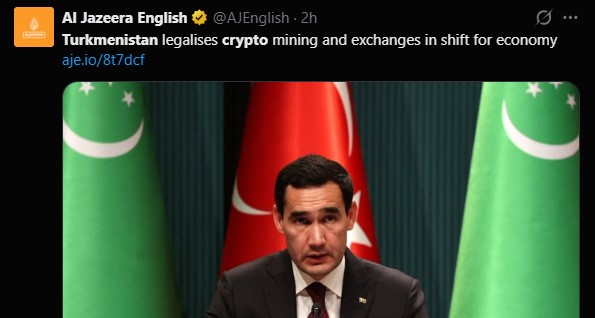
Turkmenistan crypto step highlights a rare economic opening for one of the world’s most closed nations. It also shows how cryptocurrencies developed themselves and are now emerging as a global means of economy.
In a short term, we can say, when many countries restrict cryptocurrencies, Turkmenistan is doing the opposite – but on its own terms.
What Are Turkmenistan Crypto Mining and Exchanges Rules
The digital asset framework comes from the Law on VIRTUAL Assets, signed by President Serdar Berdimuhamedov on Nov 28, 2025 and set for January 1, 2026 enforcements. It creates the first clear and legal structure for cryptocurrency in Turkmenistan, placing all related activities under Central Bank oversight.
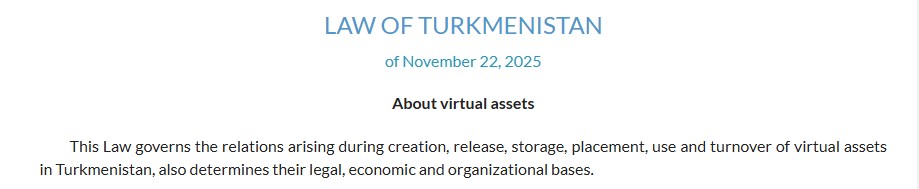
The law allows crypto mining, including mining pools. Both native businesses and foreign participants, registered ones, can mine digital coins after completing necessary E-registration. On the other side, the government has clearly banned “hidden” or unregistered mining-operations.
For trading exchanges, the service providers are also legal, but only with license. Licensed trading platforms must follow:
Strict KYC and AML (Anti-Money Laundering) rules
Keep most of the users fund into cold wallets (hard storing devices)
Protection of user sensitive data
Reporting of any suspicious activity
However, the law makers cleared the thing that cryptocurrencies are not legal tender. In simple words, they cannot be used to pay for goods or services and are not recognized as money, securities, or any electronic payment tools.
Here the question arises as if the nation doesn’t want to give digital coin a regular money status then why did it introduce cryptocurrency mining and exchange laws?
Why Turkmenistan Is Turning to Crypto Now
This policy shift reflects a broader economic strategy. Turkmenistan’s major economy heavily relies on natural gas. The nation holds the world’s fourth-largest gas reserves. By legalizing crypto minings, the government aims to monetize cheap energy while reducing dependence on gas exports.
The MOVE also aligns with the efforts to advance state services and cautiously open the economy since President Berdimuhamedov took office in 2022. Regulated digitalization is now seen as an instrument to attract foreign capital without loosening the central authority.
Opportunities and Limits for Crypto Mining in Turkmenistan
For miners, the biggest attraction is energy cost. Cheap gas-powered electricity could make crypto mining profitable, especially for international operations seeking new spaces.
At the same time, challenges remain:
Limited access to Internet,
Underdeveloped infrastructures,
And tight control of the state over every digital activities
Adding on, regional competition also matters. Neighboring countries like Kazakhstan and Uzbekistan already host established mining sectors, while Kyrgyzstan has moved further by launching a Binance-backed stablecoin.
As they are established ahead of Turkmenistan, it is obvious for them to have a more developed environment for the investors.
These factors may slow down adoption despite the legal green light. But as the space continues to expand, developments gain popularity, growth is obvious.
Increasing Number in Central Asia's Map
Central Asia has steadily become a key region for regulated virtual currency growth over the past few years. Countries such as Kazakhstan, Uzbekistan, and Kyrgyzstan have already legalized crypto's extraction and trading under government supervision.
With the Turkmenistan crypto's law now in force, the region is shaping into a state-regulated digital coin generation corridor rather than a free-market hub. Central Asia’s role in global cryptocurrency infrastructure, showing how energy-rich nations are cautiously embracing digital assets without allowing them to replace national currencies.
However, from the main five central Asian countries, four had already marked their entry, leaving only Tajikistan behind. So, can the community expect the next announcement from Tajikistan, especially when it recently banned cryptocurrency mining over electricity theft?
